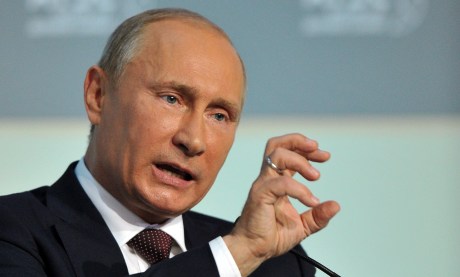
ALEXANDER KADOBNOV/AFP/GettyImages
“if someone is not happy with our stance, they could find a better option than declaring us an enemy every time. Would not it be better to listen to us, to critically reflect on what we say, to agree to something and to look for a common solution?” -Vladimir Putin, 5 January 2016
Vladimir Putin’s interview with [German newspaper] Bild:
Bild: Mr President, We have just marked the 25th anniversary of the end of the Cold War. Last year, we witnessed a great number of wars and crises across the world, something that had not happened for many years. What did we do wrong?
President of Russia Vladimir Putin: You have started just with the key question. We did everything wrong from the outset. We did not overcome Europe’s division: 25 years ago the Berlin Wall fell, but Europe’s division was not overcome, invisible walls simply moved to the East. This created the foundation for mutual reproaches, misunderstanding, and crises in the future. Many people, including in the Federal Republic [of Germany], criticise me for my well-known speech at the Munich Conference on Security. But what was so unusual that I said?
After the Berlin Wall fell, there were talks that NATO would not expand to the East. As far as I remember, the then Secretary General of NATO, national of the Federal Republic Manfred Woerner said that. By the way, some German politicians of that time gave warnings and proposed their solutions, for example, Egon Bahr.
You know, before meeting with German journalists I, naturally, thought that we would anyway come to the issue you have touched upon now, so I took archived records of talks of that period (1990) between Soviet leaders and some German politicians, including Mr Bahr. They have never been published.
Bild: Are these interviews?
Vladimir Putin: No, these are working discussions between German politicians Genscher, Kohl, Bahr and Soviet leadership (Mr Gorbachev, Mr Falin, who, I think, headed the International Division of the Central Committee of the Communist Party). They have never been made public. You and your readers will be the first to learn about this talk of 1990. Look what Mr Bahr said: “If while uniting Germany we do not take decisive steps to overcome the division of Europe into hostile blocs, the developments can take such an unfavourable turn that the USSR will be doomed to international isolation.” That was said on June 26, 1990.
Mr Bahr made concrete proposals. He spoke about the necessity to create a new alliance in the centre of Europe. Europe should not go to NATO. The whole of Central Europe, either with East Germany or without it, should have formed a separate alliance with participation of both the Soviet Union and the United States. And then he says: “NATO as an organisation, at least its military structures must not extend to include Central Europe.” At that time, he already was the patriarch of European politics, he had his own vision of Europe’s future, and he was telling his Soviet colleagues: “If you do not agree with it, but on the contrary agree with NATO’s expansion, and the Soviet Union agrees with it, I will never come to Moscow again.” You see, he was very smart. He saw a deep meaning in that, he was convinced that it was necessary to change the format radically, move away from the times of the Cold War. But we did nothing.
Bild: Did he come to Moscow again?
Vladimir Putin: I do not know. This talk took place on February 27, 1990. This is a record of the conversation between Mr Falin representing the Soviet Union and Mr Bahr and Mr Voigt representing German politicians.
So what has actually happened? What Mr Bahr had warned about – that’s what has happened. He warned that the military structure – the North Atlantic Alliance – must not expand to the East. That something common, uniting the whole of Europe must be created. Nothing like that has happened; just the opposite has happened what he had warned about: NATO started moving eastwards and it expanded.
We have heard a thousand times the mantra from our American and European politicians, who say: “Each country has the right to choose its own security arrangements.” Yes, we know that. This is true. But it is also true that other countries have the right to make decisions to expand their own organisation or not, act as they consider appropriate in terms of global security. And leading NATO members could have said: “We are happy that you want to join us, but we are not going to expand our organisation, we see the future of Europe in a different way.”
In the last 20–25 years, especially after the collapse of the Soviet Union when the second centre of gravity in the world disappeared, there was a desire to fully enjoy one’s sole presence at the pinnacle of world fame, power and prosperity. There was absolutely no desire to turn either to international law or to the United Nations Charter. Wherever they became an obstacle, the UN was immediately declared outdated.
Apart from NATO’s expansion eastwards, the anti-ballistic missile system has become an issue in terms of security. All this is being developed in Europe under the pretext of addressing the Iranian nuclear threat.
In 2009, current President of the United States Barack Obama said that if Iran’s nuclear threat no longer existed there would be no incentive for establishing the ABM system; this incentive would disappear. However, the agreement with Iran has been signed. And now the lifting of sanctions is being considered, everything is under the IAEA control; first shipments of uranium are already being transported to the Russian territory for processing, but the ABM system is being further developed. Bilateral agreements have been signed with Turkey, Romania, Poland, and Spain. Naval forces that should operate as part of missile defence are deployed in Spain. A positioning area has already been created in Romania, another one will be created in Poland by 2018; a radar is being installed in Turkey.
We strongly objected to developments taking place, say, in Iraq, Libya or some other countries. We said: “Don’t do this, don’t go there, and don’t make mistakes.” Nobody listened to us! On the contrary, they thought we took an anti-Western position, a hostile stance towards the West. And now, when you have hundreds of thousands, already one million of refugees, do you think our position was anti-Western or pro-Western?
Bild: As far as I understood, you have summed up the mistakes made by the West with regard to your country. Do you believe that Russia on its part has made any during these 25 years?
Vladimir Putin: Yes, it has. We have failed to assert our national interests, while we should have done that from the outset. Then the whole world could have been more balanced.
Bild: What you just said, does that mean that starting from 1990–1991, after the collapse of the Soviet Union, all the years after it, Russia has failed to clearly assert its national interests?
Vladimir Putin: Absolutely.
Bild: We know that you have special attitude towards Germany. Ten years ago in an interview given to us on the occasion of the 60th anniversary of the end of World War II you said: “Russia and Germany have never been so close to each other as they are now.”
What do you believe has been left of that closeness to this day?
Vladimir Putin: Our relations are based, most importantly, on mutual attraction of our peoples.
Bild: So nothing has changed in this respect?
Vladimir Putin: I think, no. Despite all the attempts (you and your colleagues have been making) to upset our relations using mass media and anti-Russia rhetoric, I believe that you have failed to do this to the extent that you wanted to. Of course, I do not mean you personally. I refer to the media in general, including German ones. In Germany, the media are under a strong foreign influence, first and foremost from the other side of the Atlantic.
You have said that I have summed up everything that we see as the mistakes made by the West. That was far from everything, I have named but a few most important points. After the Soviet Union collapsed, equally adverse processes emerged inside Russia itself. Those included a drop in industrial production, the collapse of social system, separatism, and the most evident onslaught of international terrorism.
Certainly, we are responsible, there is no one but us to blame. At the same time, for us it was an obvious fact that the international terrorism was also used as a means of fighting against Russia, while everyone either turned a blind eye on that or provided support to terrorists (I refer to political, information, financial or in some cases even armed support to the actors fighting against the Russian state). Certainly, at that moment we realised that discussions and geopolitical interests are completely different things.
As for the Russian-German relations, indeed, they reached an excellent level in 2005, and would have developed successfully further. The trade turnover between our two countries grew to over $80 billion.
In Germany, a huge number of jobs were created thanks to Russian-German cooperation. We tried to prevent negative developments in the Middle East, particularly in Iraq, together.
We made major steps in furthering our energy cooperation. A lot of German entrepreneurs opened businesses in Russia, and thousands of enterprises were established. Exchanges between our citizens expanded, and humanitarian contacts developed. The Petersburg Dialogue public forum was also established at that time.
As I have said, our trade turnover used to reach $83–85 billion, and in the first months of 2015 it fell by half. I believe as of the end of the year it will stand at about $40 billion, at 50 percent of what it was. Nevertheless, we maintain relations, and the Federal Chancellor and I meet regularly at various events. I think, I met her seven times, and had 20 telephone conversations with her in 2015. We still hold reciprocal Years of the Russian Language and Literature in Germany and Years of the German Language and Literature in Russia. This year is to be the year of youth exchanges. So the relations are still developing, thank God, and I hope they will develop further. We will overcome the difficulties we are facing today.
Bild: If I got you right, NATO should have told the East European states there and then that it would not admit them? Do you believe NATO could have survived that?
Vladimir Putin: Certainly.
Bild: Yet this has been set forth in the NATO Charter.
Vladimir Putin: The Charter is written by people, isn’t it? Does the Charter say that NATO is obliged to admit everyone who would like to join? No. There should be certain criteria and conditions. If there had been political will, if they had wanted to, they could have done anything. They just did not want to. They wanted to reign.
So they sat on the throne. And then? And then came crises that we are now discussing. If they had followed the advice the old wise German, Mr Egon Bahr gave them, they would have created something new that would unite Europe and prevent crises. The situation would have been different, there would have been different issues. Perhaps they would not have been that acute, you see.
Bild: There is a theory saying that there are two Mr Putins: the first one was young pre-2007 Mr Putin who showed solidarity with the United States and who was friends with Mr Schroeder, and then, after 2007, another Mr Putin came. Back in 2000 you said, “We should have no confrontations in Europe, we should do everything to overcome them.” And now we have found ourselves in such confrontation.
May I ask you a straightforward question? When we are going to have the first Mr Putin back?
Vladimir Putin: I have never changed. First, I still feel young today. I was and I continue to be Mr Schroeder’s friend. Nothing has changed.
My attitude to such issues as the fight against terrorism has not changed either. It is true, on September 11 I was the first to call President Bush and express my solidarity. Indeed, we stood ready to do everything to combat terrorism together. Not so long ago, after the terrorist attacks in Paris, I called and then met the President of France.
If anyone had listened to Gerhard Schroeder, to Jacques Chirac, to me, perhaps there would have been none of the recent terrorist attacks in Paris, as there would have been no upsurge of terrorism in Iraq, Libya, or other countries in the Middle East.
We are faced with common threats, and we still want all countries, both in Europe and the whole world, to join their efforts to combat these threats, and we are still striving for this. I refer not only to terrorism, but also to crime, trafficking in persons, environmental protection, and many other common challenges. Yet this does not mean that it is us who should agree with everything that others decide on these or other matters. Furthermore, if someone is not happy with our stance, they could find a better option than declaring us an enemy every time. Would not it be better to listen to us, to critically reflect on what we say, to agree to something and to look for a common solution? That was what I referred to at the celebration of the 70th anniversary of the United Nations in New York.
Bild: I would like to express the view that today the fight against Islamic terrorism is such an acute issue that it could bring Russia and the West back together in this fight, but the problem of Crimea arises. Is Crimea really worth putting cooperation with the West at stake?
Vladimir Putin: What do you mean when you say ‘Crimea’?
Bild: Redrawn boundaries.
Vladimir Putin: And what I mean is people – 2.5 million of them. These are the people that were frightened by the coup; let’s be frank, they were worried by the coup d’état in Ukraine. And after the coup in Kiev – and it was nothing but a coup d’état, no matter how the extreme nationalist forces, the forces that were coming to power at that moment and largely stayed there, tried to sugar it up – they just began to openly threaten people. To threaten Russians and Russian-speaking people living in Ukraine and in Crimea in particular, because it was more densely populated by Russians and Russian-speaking than other parts of Ukraine.
What was our reaction? We did not make war, nor did we occupy anyone; there was no shooting, no one got killed during the events in Crimea. Not a single person! We used the Armed Forces only to stop more than 20,000 Ukrainian service members stationed there from interfering with the free expression of will by the residents of Crimea. People came to the referendum and cast their vote. They chose to be part of Russia.
Here is a question: what is democracy? Democracy is the will of the people. People voted for the life they wanted. It is not the territory and borders that I am concerned about but the fates of people.
Bild: But borders are a component of the European political order. You have previously said that this is actually very important, including in the context of the NATO expansion.
Vladimir Putin: It is important to always respect international law. In Crimea, there was no violation of international law. Under the United Nations Charter, every nation has the right to self-determination. Concerning Kosovo, the UN International Court of Justice ruled that, when it comes to sovereignty, the opinion of the central government can be ignored. If you are a serious periodical that is honest with its readers, find the transcript of the statement made by the German representative in the International Court of Justice in the archives and cite it. Take the letter, which I believe was written by the US Department of State, or the statement made by the British representative. Find them and read them. Kosovo declared its independence, and the whole world accepted it. Do you know how it in fact happened?
Bild: After the war?
Vladimir Putin: No, it was done by a decision of the Parliament. There was even no referendum held.
What happened in Crimea? Firstly, the Crimean Parliament was elected in 2010, that is when Crimea was still part of Ukraine. This fact I am talking about is extremely important. The Parliament that had been elected while Crimea was part of Ukraine met and voted for independence and called a referendum. Then the citizens voted at the referendum for reunification with Russia. Moreover, as you pointed out quite correctly, the events in Kosovo took place after several years of war and the de-facto intervention by NATO countries, after the bombing of Yugoslavia and missile strikes targeting Belgrade.
Now I want to ask you this: if the Kosovans in Kosovo have the right to self-determination, why don’t the Crimeans have the same right? If we want the relations between Russia and our friends and neighbours in Europe and around the world to develop in a positive and constructive manner, at least one condition must be observed: we need to respect each other, each other’s interests and follow the same rules instead of constantly changing them to suit someone’s interests.
You asked me if I was a friend or not. The relations between states are a little different from those between individuals. I am no friend, bride or groom; I am the President of the Russian Federation. That is 146 million people! These people have their own interests, and I must protect those interests. We are ready to do this in a non-confrontational manner, to look for compromise but, of course, based on international law, which must be understood uniformly by all.
Bild: If, as you say, there was no violation of international law in Crimea, how can you explain to your people that because of that step the West, including at Ms Merkel’s initiative, imposed sanctions against Russia that the Russian population is now suffering from?
Vladimir Putin: You know, the Russian people feel in their hearts and understand in their minds very well what is happening. Napoleon once said that justice is the embodiment of God on earth. In this sense, the reunification of Crimea with Russia was a just decision.
As to the reaction of our western partners, I believe that it was wrong and it was not aimed at supporting Ukraine but at suppressing the growth of Russia’s capabilities. I believe that this should not be done and this is the main mistake; on the contrary, we need to use each other’s capabilities for mutual growth, to address common issues together.
You have mentioned sanctions. In my view, this was a foolish decision and a harmful one. I have said that our turnover with Germany amounted to $83–85 billion, and thousands of jobs were created in Germany as a result of this cooperation. And what are the restrictions that we are facing? This is not the worst thing we are going through, but it is harmful for our economy anyway, since it affects our access to international financial markets.
As to the worst harm inflicted by today’s situation, first of all on our economy, it is the harm caused by the falling prices on our traditional export goods. However, both the former and the latter have their positive aspects. When oil prices are high, it is very difficult for us to resist spending oil revenues to cover current expenses. I believe that our non-oil and gas deficit had risen to a very dangerous level. So now we are forced to lower it. And this is healthy…
Bild: For the budget deficit?
Vladimir Putin: We divide it. There is the total deficit and then there are non-oil and gas revenues. There are revenues from oil and gas, and we divide all the rest as well.
The total deficit is quite small. But when you subtract the non-oil and gas deficit, then you see that the oil and gas deficit is too large. In order to reduce it, such countries as Norway, for example, put a significant proportion of non-oil and gas revenues into the reserve. It is very difficult, I repeat, to resist spending oil and gas revenues to cover current expenses. It is the reduction of these expenses that improves the economy. That is the first point.
Second point. You can buy anything with petrodollars. High oil revenues discourage development, especially in the high technology sectors. We are witnessing a decrease in GDP by 3.8 percent, in industrial production by 3.3 percent and an increase in inflation, which has reached 12.7 percent. This is a lot, but we still have a surplus in foreign trade, and the total exports of goods with high added value have grown significantly for the first time in years. That is an expressly positive trend in the economy.
The reserves are still at a high level, and the Central Bank has about 340 billion in gold and foreign currency reserves. If I am not mistaken, they amount to over 300. There are also two reserve funds of the Government of the Russian Federation, each of which amounts to $70 to $80 billion. One of them holds $70 billion, the other – $80 billion. We believe that we will be steadily moving towards stabilisation and economic growth. We have adopted a whole range of programmes, including those aimed at import replacement, which means investing in high technologies.
Bild: You have often discussed the issue of sanctions as well as the issue of Crimea with Federal Chancellor Angela Merkel. Do you understand her? Do you trust her?
Vladimir Putin: I am certain that she is a very sincere person. There is a framework within which she has to work but I have no doubt that she is sincere in her efforts to find solutions, including to the situation in southeast Ukraine.
You spoke of sanctions. Everyone says that the Minsk Agreements must be implemented and then the sanctions issue may be reconsidered. This is beginning to resemble the theatre of the absurd because everything essential that needs to be done with regard to implementing the Minsk Agreements is the responsibility of the current Kiev authorities. You cannot demand that Moscow do something that needs to be done by Kiev. For example, the main, the key issue in the settlement process is political in its nature and the constitutional reform lies in its core. This is Point 11 of the Minsk Agreements. It expressly states that the constitutional reform must be carried out and it is not Moscow that is to make these decisions.
Look, everything is provided for: Ukraine is to carry out a constitutional reform with its entry into force by the end of 2015 (Paragraph 11). Now 2015 is over.
Bild: The constitutional reform must be carried out after the end of all military hostilities. Is that what the paragraph says?
Vladimir Putin: No, it is not.
Look, I will give you the English version. What does it say? Paragraph 9 – reinstatement of full control of the state border by the government of Ukraine based on the Ukrainian law on constitutional reform by the end of 2015, provided that Paragraph 11 has been fulfilled, which stipulates constitutional reform.
Consequently, the constitutional reform and political processes are to be implemented first, followed by confidence building on the basis of those reforms and the completion of all processes, including the border closure. I believe that our European partners, both the German Chancellor and the French President should scrutinise these matters more thoroughly.
Bild: Do you think this is not so?
Vladimir Putin: I think they have a lot of problems of their own. But if we are addressing this matter then we must scrutinise it. For example, it says here that changes to the Constitution should be permanent. The Ukrainian Government introduced the law on the special status of those territories, a law that had been adopted earlier, into the transitional provisions. But this law, which they incorporated in the Constitution, was adopted for the duration of three years only. Two years have already passed. When we met in Paris, both the German Chancellor and the French President agreed that this law should be changed and included in the Constitution on a permanent basis. Both the President of France and the Chancellor of Germany confirmed that. Moreover, the current version of the Constitution has not even been approved and the law has not become permanent. How can demands be made on Moscow to do what in fact must be done inline with the decisions of our colleagues in Kiev?
Bild: What is your attitude towards the Federal Chancellor now? You said some time ago that you admired many of her personal qualities. How do things stand now?
Vladimir Putin: When did I say that?
Bild: That you respect her.
Vladimir Putin: I feel the same way now. I have already said that she is very sincere and highly professional. In any case, I think the level of trust between us is very high.
Bild: Let me ask you a personal question. When the Federal Chancellor visited you in Sochi in January 2007, did you know that she was afraid of dogs?
Vladimir Putin: No, of course not. I did not know anything about that. I showed her my dog because I thought she would like it. I told her so later and apologised.
Bild: Mr President, will you take any steps to re-establish the G7 format as the G8?
And another question: what did you think when the US President said that Russia is a regional power?
Vladimir Putin: I did not think anything in particular. Every individual, all the more so the President of the United States, is entitled to his or her own opinion on anything, on partners and on other countries. That is his own opinion, as I also know his opinion that the American nation, the United States is unique. I cannot agree with either of those opinions.
Let me clarify a few things about Russia. First, we do not claim the role of a superpower. This role is very costly and it is meaningless. Our economy is fifth or sixth in the world in terms of volume. It may have moved down to a lower place at present taking into account the economic difficulties I have mentioned but we are confident that we have very good development prospects and potential. We occupy, roughly, the sixth place in the world in terms of purchasing power parity.
If we say that Russia is a regional power, we should first determine what region we are referring to. Look at the map and ask: “What is it, is it part of Europe? Or is it part of the eastern region, bordering on Japan and the United States, if we mean Alaska and China? Or is it part of Asia? Or perhaps the southern region?” Or look at the north. Essentially, in the north we border on Canada across the Arctic Ocean. Or in the south? Where is it? What region are we speaking about? I think that speculations about other countries, an attempt to speak disrespectfully about other countries is an attempt to prove one’s exceptionalism by contrast. In my view, that is a misguided position.
Bild: And what about the G8?
Vladimir Putin: We planned to host the G8 summit in 2014. I think Russia never became a full-fledged G8 member, since there were always separate negotiations between foreign ministers of the other seven countries. I would not say that this mechanism is useless. Meetings, discussions, seeking solutions together are always beneficial.
I believe that Russia’s presence was useful, since it provided an alternative view on some issues under discussion. We examine pretty much the same issues within the G20, APEC in the East and within BRICS. We were ready to host the G8 summit in 2014. It was not us who did not go somewhere; other countries did not come to Russia. If our counterparts decide to come for a visit, they will be most welcome, but we have not booked any tickets yet.
Bild: What do you think about the possibility of re-establishing cooperation, if not within the G8, then, perhaps, with NATO? There was the Russia-NATO Council after all, and you conducted joint military exercises. Is there a chance to re-establish such cooperation or should we forego the prospect altogether?
Vladimir Putin: At the outset, the idea of creating the Council was actively supported, if not initiated, by Mr Berlusconi, the former Prime Minister of Italy, and I believe it was in Italy that we signed the document on establishing the Russia-NATO Council. It was not Russia that cut off cooperation through the G8 or the Russia-NATO Council. We are willing to interact with everyone, once there is a matter for common discussion. We think that there is one, but a relationship can be happy only when the feeling is mutual. If we are not welcome as partners, that is fine with us then.
Bild: Regrettably, at the moment the Russia-NATO relations are at the stage of confrontation, rather than cooperation. Turkish military forces have downed a Russian aircraft, and Russian and Turkish warships are reported to come dangerously close to one another all the more often. Do you think that such developments may at a certain point cause an escalation from a cold war to actual hostilities?
Vladimir Putin: Turkey is a NATO member. However, the problems that have emerged have nothing to do with Turkey’s NATO membership; nobody has attacked Turkey. Instead of trying to provide us with an explanation for the war crime they committed, that is, for downing our fighter jet that was targeting terrorists, the Turkish government rushed to NATO headquarters seeking protection, which looks quite odd and, in my view, humiliating for Turkey.
I repeat, NATO has to protect its members from attack, but nobody has attacked Turkey. If Turkey has vested interests elsewhere in the world, in the adjacent countries, does it mean that NATO must protect and secure these interests? Does it mean that Germany, as a NATO member, must help Turkey to expand into neighbouring territories?
I hope that such incidents will not cause large-scale hostilities. Of course, we all realise that Russia, once under threat, would defend its security interests by all available means at its disposal, should such threats against Russia arise.
Bild: Now let’s turn to Syria, if you do not mind.
We say that we are tackling common challenges there. This is the joint fight against ISIS in Iraq and Syria. However, some people in the West say that Russian military forces in Syria are fighting the anti-Assad rebels, rather than ISIS. What would be your response to the allegations that Russia is hitting the wrong targets?
Vladimir Putin: They are telling lies. Look, the videos that support this version appeared before our pilots even started to carry out strikes against terrorists. This can be corroborated. However, those who criticise us prefer to ignore it.
American pilots hit the Doctors Without Borders hospital in Kunduz, Afghanistan, by mistake, I am sure. There were casualties and fatalities among civilians and doctors. Western media outlets have attempted to hush this up, to drop the subject and have a very short memory span when it comes to such things. They mentioned it a couple of times and put it on ice. And those few mentions were only due to foreign citizens from the Doctors Without Borders present there.
Who now remembers the wiped out wedding parties? Over 100 people were killed with a single strike.
Yet this phony evidence about our pilots reportedly striking civilian targets keeps circulating. If we tag the “live pipelines” that consist of thousands of petrol and oil tankers as civilian targets, than, indeed, one might believe that our pilots are bombing these targets, but everyone is bombing them, including the Americans, the French and everyone else.
Bild: However, it is clear that Syrian President Bashar al-Assad is carrying out strikes against his own population. Can we say that al-Assad is your ally?
Vladimir Putin: You know, this is a rather subtle issue. I think that President al-Assad has made many mistakes in the course of the Syrian conflict. However, don’t we all realise full well that this conflict would never have escalated to such a degree if it had not been supported from abroad through supplying money, weapons and fighters? Tragically, it is civilians who suffer in such conflicts.
But who is responsible for that? Is it the government, which seeks to secure its sovereignty and fights these anti-constitutional actions, or those who have masterminded the anti-government insurgency?
Regarding your question if al-Assad is an ally or not and our goals in Syria. I can tell you precisely what we do not want to happen: we do not want the Libyan or Iraqi scenario to be repeated in Syria. I have to give due credit to Egyptian President Abdel Fattah el-Sisi, and I told him this myself, because had he not taken on the responsibility, demonstrated fortitude and brought the country under control, then we might have witnessed the Libyan scenario in Egypt. In my view, no effort should be spared in strengthening legitimate governments in the region’s countries. That also applies to Syria. Emerging state institutions in Iraq and in Libya must be revived and strengthened. Situations in Somalia and other countries must be stabilised. State authority in Afghanistan must be reinforced. However, it does not mean that everything should be left as is. Indeed, this new stability would underpin political reforms.
As far as Syria is concerned, I think that we should work towards a constitutional reform. It is a complicated process. Then, early presidential and parliamentary elections should be held, based on the new Constitution. It is the Syrian people themselves who must decide who and how should run their country. This is the only way to achieve stability and security, to create conditions for economic growth and prosperity, so that people can live in their own homes, in their homeland, rather than flee to Europe.
Bild: But do you believe al-Assad is a legitimate leader if he allows the destruction of his country’s population?
Vladimir Putin: It is not his goal to destroy his country’s population. He is fighting those who rose up against him with deadly force. And if the civilians suffer, I think that the primary responsibility for this is with those who fight against him with deadly force as well as those who assist armed groups.
As I have already said, though, this does not mean that everything is all right out there and that everyone is right. This is exactly why I believe political reforms are needed so much there. The first step in that direction should be to develop and adopt a new Constitution.
Bild: If, contrary to expectations, al-Assad loses the elections, will you grant him the possibility of asylum in your country?
Vladimir Putin: I think it is quite premature to discuss this. We granted asylum to Mr Snowden, which was far more difficult than to do the same for Mr al-Assad.
First, the Syrian people should be given the opportunity to have their say. I assure you, if this process is conducted democratically, then al-Assad will probably not need to leave the country at all. And it is not important whether he remains President or not.
You have been talking about our targets and means, and now you are talking about al-Assad being our ally. Do you know that we support military operations of the armed opposition that combats ISIS? Armed opposition against al-Assad that is fighting ISIS. We coordinate our joint operations with them and support their offensives by airstrikes in various sections of the frontline. This is hundreds, thousands of armed people fighting ISIS. We support both the al-Assad’s army and the armed opposition. Some of them have publicly declared this, others prefer to remain silent, but the work is on-going.
Bild: Finally, I would like to touch upon a topic that has never come up before, that is the rift between Saudi Arabia and Iran, as if Syria was not enough. Does it mean that this rift can lead us to a very grave conflict?
Vladimir Putin: It hampers the efforts to settle the Syrian crisis and the fight against terrorism, as well as the process of halting the inflow of refugees to Europe, that much is certain.
As for whether this will lead to a major regional clash, I do not know. I would rather not talk or even think in these terms. We have very good relations with Iran and our partnership with Saudi Arabia is stable.
Of course, we regret that these things happened there. But you have no death penalty in your country, right? Despite a very hard period in the 1990s–early 2000s, when we were fighting terrorism in Russia, we abolished the death penalty. And there is no death penalty in Russia at present. There are certain countries that use the death penalty – Saudi Arabia, the United States and some others.
We regret this has happened, especially given that the cleric had not been fighting against Saudi Arabia with lethal force. Yet it is true that an embassy attack is a totally unacceptable occurrence in the modern world. As far as I know, the Iranian authorities have arrested several perpetrators of the assault. If our participation in any form is needed, we are ready to do everything possible to resolve the conflict as soon as possible.
Bild: One last question, Mr President.
During the preparations for the Winter Olympics in Sochi, there was heavy criticism in the West of democratic development and human rights situation in Russia. Do you expect similar criticism to arise again during the preparations for the 2018 FIFA World Cup?
I think the Russian language is more extensive than German. (Noting the long translation of the question from German into Russian.)
Vladimir Putin: I would say the German language is more precise.
The Russian language is more diverse, more elegant. However, such genius minds as, say, Goethe make the German language sound very elegant and beautiful. One can feel its beauty only in German, and to be able to feel it one needs to understand it.
As far as democracy is concerned, the ruling classes usually talk about freedom to pull the wool over the eyes of those whom they govern. There is nothing new about democracy in Russia. As we have already identified, democracy is the rule of the people and the influence of the people over the authorities. We have learned very well the lesson of one-party rule – that of the Communist Party (CPSU). Therefore, we made our choice long ago and we will continue developing democratic institutions in our country. At present, 77 political parties can take part in parliamentary elections in Russia. We have come back to direct gubernatorial elections.
We are advancing the instruments of direct democracy, meaning various public organisations, and will continue to do so. There can be no identical clichés in democracy – be it American, European (German), Russian or Indian. Do you know that twice in American history the President was elected by the majority of delegates representing the minority of voters? Does it mean the absence of democracy? Of course not. But it is not the only or the most important problem. One of the European leaders once told me: “In the United States it is impossible to run for presidency without a few billion dollars in your pocket.”
Now, regarding the parliamentary system of democracy.
I am repeatedly asked: “How long have you been President?” But in a parliamentary democracy, the person number one is the Prime Minister, who can head the Government an unlimited number of times.
We have returned to direct elections of regional heads. In some countries, however, heads of regions are appointed by the central government. I am not sure, I may be wrong, it is probably better to leave it out or to double-check it, but, as far as I know, that is the case in India.
We still have a number of problems to solve before people feel confident that they have real influence over the authorities and that the authorities respond to their demands. We are going to work towards improving our instruments.
As for the attempts to use sport in political rifts and political competition, I believe that is a huge mistake. That is what stupid people do. If problems arise, particularly at the interstate level, sport, art, music, ballet and opera are the very means that should bring people closer together rather than divide them. It is vital to foster this role of art and sport rather than belittle and suppress it.
Bild: Thank you, Mr President, for a wonderful and very detailed conversation.






 Ronald Thomas West