Archives for category: Uncategorized

ObamaPick

^ Sauron

sardonic |särˈdänik|
adjective
grimly mocking or cynical: Stoner attempted a sardonic smile.
DERIVATIVES
sardonically |-ik(ə)lē| adverb.
sardonicism |-ˈdänəˌsizəm| noun
ORIGIN mid 17th cent.: from French sardonique, earlier sardonien, via Latin from Greek sardonios ‘of Sardinia,’ alteration of sardanios, used by Homer to describe bitter or scornful laughter.

Sardonicism is an unnecessarily clumsy word. So, I’ve changed it to ‘sardonism.’ With an English language lexicon of one million words, no one should notice one more, you think? Sardonism could refer to a religion dedicated to minimizing our world’s problems or, alternatively, reducing our political leadership to the lowest common denominator. Think of ‘moroncy’ as in ‘I dub thee peer in the realm of morons.’ Sort of like the Queen creates peerages and made Maggie Thatcher a Baroness (‘moroness’ actually) … recalling Mitterrand had observed Maggie having ‘the eyes of Caligula.’ A perfect example of practicing ‘sardonism.’

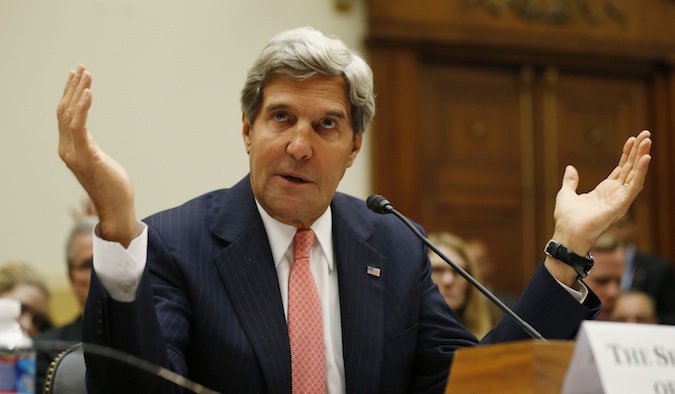
Now, it also occurs to me I like the word ‘sardonism’ because it somewhat rhymes with ‘sauronism’, that is, if we assume there are people who worship Sauron. You know, tossing that cursed ring into the fires of Mount Doom. ‘Ohhh, my precious…’ so where the fuck is Frodo when you most need him? Because today I was watching the wretched sorcerer Saruman, ah-hem, I actually meant John Kerry, expressing his ‘grave concerns’ about the growing forces of al Qaida in Syria spilling over to Iraq.

U.S. Secretary of State John Kerry testifies at a U.S. House Foreign Affairs Committee hearing on Syria on Capitol Hill in Washington

^ “I have no idea how al Qaida gained control”

John Kerry, I hereby dub thee peer in the Realm of Morons, Puke of Hypocrites, and Prince of Knavery.

knave |nāv|
noun archaic
a dishonest or unscrupulous man.
DERIVATIVES
knavery |-vərē| noun (pl. knaveries)
ORIGIN Old English cnafa ‘boy, servant’; related to German Knabe ‘boy.’

In the German : ’boy.’ Perfect.

Conveniently, as a child who only lives in the moment, self-serving Kerry neglects to remember who made the arrangement which has al Qaida affiliated ‘opposition’ groups largely in control of ‘rebel’ held areas of Syria and taking over Iraq. Nothing like making a George Bush lie of Iraq a safe harbor for al Qaida into a reality, eh?

Sort of like when children play ‘Cowboys and Indians’, you can shift sides at will, pursue make-believe with any story line, and, of course, rewrite history as the imaginary play goes on. But, what is the real storyline for those who will be charged with fixing the neighborhoods broken windows with the game spun out of control?

ALEPPO

^ Aleppo, Syria

Many of us have heard the vulgar slang ‘circle-jerk’ and ‘cluster-fuck’ but what is the term to describe the group fellatio of John McCain, Joe Lieberman, John Kerry and Barack Obama, all failed personalities in foreign policy whose most consuming ambition had been to be President of the United States? With political blow-jobs all around, these ‘dukes of hazard’ pushed into play the CIA working with Saudi Arabia to arm the Syrian ‘opposition.’ The USA provided the training and facilitated Saudi Arabia (among others) funneling arms to the so-called ‘rebels.’ Trained and armed, where do these ‘rebels’ end up? Where the most money and narcissistic prestige (outside of Washington DC) is, that is al Qaida. Why thank you John & Joe McLieberman!

McLiberman

Picking out a bed at Ikea

The result? Al Qaida affiliates are the most effective force in the USA’s effort to topple Assad, as the ‘opposition’ is going to the Geneva talks with its tail tucked firmly between its legs in face of groups it actually cannot represent in control of major areas held by Syrian ‘rebels.’

Meanwhile, the newly most powerful armed ‘opposition’ group in Syria superseding the al Qaida affiliate al Nusra is al Qaida affiliate Islamic State of Iraq and the Levant, re-expanding its presence in Iraq, taking back Falluja (how many American marines died there?), much of Ramadi and is threatening Bagdad itself. How do you suppose al Qaida got the weapons and training to do this? (see preceding.) Oh and then the ‘Islamic State’ became so extreme, they were disowned by al-Qaida!

These boys who play Cowboys and Indians, smashing the neighborhood windows in the process, at the age of McCain, Lieberman, Kerry and Obama, are clearly boys who never grew up. Is there anyone can take these kids by the ear and march them to a stool where they can be made to sit in a corner? Don’t hold your breath waiting for this to happen, just pray for Frodo.

The Satires

*

Related links

http://news.yahoo.com/key-al-qaida-militant-reportedly-killed-syria-170552209.html

egregious liar

egregious |iˈgrējəs| adjective: outstandingly bad; shocking: egregious abuse of trust.

liar |ˈlīər| noun: a person who tells lies.

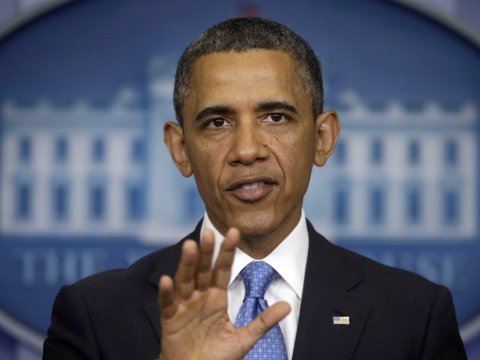
Lest anyone mistake my use of this definition in regards to Obama’s speech on the NSA, I mean this in the sense Obama is really good at telling lies. Alternatively, Obama is a pathological liar:

pathological |ˌpaTHəˈläjikəl| (also pathologic)
adjective
compulsive; obsessive: a pathological liar.

The National Security blog “Unredacted’ had yesterday quickly published a refutation of Obama’s claims with an excellent piece on official lies relating to the NSA’s surveillance programs. I will take this bit of work a bit further, pointing out how the USA has become so far removed from the rule of law as to convince our constitution has been utterly, entirely usurped, and Obama’s pro-active, purposeful participation in this world-threatening travesty. But first, keep in the back of your mind: a compulsive liar must tell an ever growing web of lies to cover any previous lies. When the liar has been busted (as Obama has in the ‘Unredacted’ blog), lies never intended to see the light of day must be covered with ‘half-truths’ completely unintended to set matters straight (i.e. more lies.)

Obama on the FISA (secret) court, June 16, 2013: “It is transparent…So, on this telephone program, you’ve got a federal court with independent federal judges overseeing the entire program. And you’ve got Congress overseeing the program, not just the intelligence committee and not just the judiciary committee — but all of Congress had available to it before the last reauthorization exactly how this program works”

Unredacted: “OpentheGovernment.org’s 2013 Secrecy Report notes, “the unchecked expansion in the growth of the government’s surveillance programs is due in large measure to the absolute secrecy surrounding the FISC and how it is interpreting the law. The FISC’s opinions interpreting Section 215 of the PATRIOT Act has allowed for a much broader collection of data than most national security and civil liberties groups, and even some Members of Congress, understood the law to permit””

Obama, June 16, 2013: “What I can say unequivocally is that if you are a U.S. person, the NSA cannot listen to your telephone calls and the NSA cannot target your e-mails”

Unredacted: “the NSA has significant latitude to collect and keep the contents of e-mails and other communications of U.S. citizens that are swept up as part of the agency’s court-approved monitoring of a target overseas.” This information is stored, for up to five years, and can be accessed as soon as the FBI gets a National Security Letter, for which there are still no requirements to seek approval or judicial review when sending”

Other than exposure of egregious lies by Obama and his minions detailed at Unredacted, the problem I have with this is the lack of challenging the secret court per se. My own position is (as a former adjunct professor of American constitutional law), there is precisely ZERO constitutional authority granted to Congress to create a secret court in Article III, section I…

“The judicial Power of the United States, shall be vested in one supreme Court, and in such inferior Courts as the Congress may from time to time ordain and establish”

…because of the Fourth Amendment language…

“The right of the people to be secure in their persons, houses, papers, and effects, against unreasonable searches and seizures, shall not be violated, and no Warrants shall issue, but upon probable cause, supported by Oath or affirmation, and particularly describing the place to be searched, and the persons or things to be seized”

…Fifth Amendment langauge…

“No person shall be held to answer for a capital, or otherwise infamous crime, unless on a presentment or indictment of a Grand Jury, except in cases arising in the land or naval forces, or in the Militia, when in actual service in time of War or public danger; nor shall any person be subject for the same offense to be twice put in jeopardy of life or limb; nor shall be compelled in any criminal case to be a witness against himself, nor be deprived of life, liberty, or property, without due process of law; nor shall private property be taken for public use, without just compensation”

…and the Sixth Amendment language…

“In all criminal prosecutions, the accused shall enjoy the right to a speedy and public trial, by an impartial jury of the State and district wherein the crime shall have been committed, which district shall have been previously ascertained by law, and to be informed of the nature and cause of the accusation; to be confronted with the witnesses against him; to have compulsory process for obtaining witnesses in his favor, and to have the Assistance of Counsel for his defense”

…with the provisions of these amendments trampled by the very existence of a secret court. All of the preceding constitutional clauses are violated by the very existence of the FISA law. Obama, who still holds a constitutional law professor position at the University of Chicago, and Chief Justice John Roberts, both, know this. What has happened is, what should be a nonexistent distinction has been created between ‘legal’ & ‘constitutional’ in the American body politic, when in fact they must be one and the same. Consequently, unconstitutional (illegal) national security laws are crafted by the congress, signed by the president and upheld by the courts, and this is how ‘color of law‘ is substituted in lieu of constitutional principles (while pretending the constitution holds sway.) Now we have, as a nation, come to accept the idea what is called ‘legal’ but is illegal, is constitutional, when in fact the national security law patently violates the constitution, a national oxymoron. The secret FISA (FISC) court John Roberts should refuse to recognize, but instead has sole authority to appoint judges to, epitomizes a ‘soft power’ coup created by congress, usurping our nation’s rule of law. And so it is Senators like Diane Feinstein can claim “PRISM is legal” while ignoring the constitution (never mind her oath to uphold the same.)

But in fact Obama and Roberts, both trained constitutional law attorneys, know there was never any necessity for a secret court having to do with ‘national security’ on account of a well known principle of American law:

in camera
adverb
‘in camera’ law in private, in particular taking place in the private chambers of a judge, with the press and public excluded: judges assess the merits of such claims in camera. The evidence of the state had been examined ‘in camera’ on national security grounds [‘in camera’, late Latin, ‘in the chamber.’]

If this known principle were applied in normal federal courts, a judge would have the discretion to reject secrecy based on her or his opinion the government’s claims of ‘national security’ were spurious, false or self-serving when balancing any national security claims against a person’s rights when pursuing eavesdropping authority (still unconstitutional in some circumstance perhaps, but by far more legal integrity is preserved because a judge can weigh a wider scope of evidence and chastise the government in open court for misbehaviors.) Obviously this will not do in any state well on its way to being usurped by fascism and is  why we have a patently unconstitutional & subversive secret court. Relevant to this run amok trashing of our foundational law:

While running a murder ring in government as vice president, international criminal Dick Cheney’s top lawyer was Shannen Coffin, Coffin is a close friend of Chief Justice John Roberts. John Roberts appoints the judges comprising the FISC (secret court.) Obama and his Attorney General Eric Holder have persistently refused to investigate and prosecute these criminal personalities, rather working to protect their interests, at the price of our foundational law (constitution’s) promises of personal liberties. Should you be asking yourself why?

Obama Attorney General Eric Holder’s Department of Justice includes the FBI which failed to investigate high profile drug cartel crimes tied directly to politicians in the USA under former Director Robert Mueller. Bush appointed Robert Mueller’s past includes stonewalling international narcotics money laundering investigations. Following on Robert Mueller, Obama appointment James Comey went from drug money laundering HSBC board director to FBI Director. What should we think about that?

Attorney General Holder had, in his past, arranged immunity for and to conceal the identities of corporate personalities responsible for providing cash and machine guns to a designated terror group:

“Holder himself, using his influence as former deputy attorney general under the Clinton Administration, helped to negotiate Chiquita’s sweeheart deal with the Justice Department in the criminal case against Chiquita. Under this deal, no Chiquita official received any jail time. Indeed, the identity of the key officials involved in the assistance to the paramilitaries were kept under seal and confidential”

And the Department of Justice’s FBI strategy:

“The FBI is committed to sharing timely, relevant, and actionable intelligence with …. the private sector as part of its national security and law enforcement missions”

Do you suppose this preceding means sharing intelligence with corporations? I expect so. So does Bloomberg:

“Thousands of technology, finance and manufacturing companies are working closely with U.S. national security agencies, providing sensitive information and in return receiving benefits that include access to classified intelligence, four people familiar with the process said. These programs, whose participants are known as trusted partners, extend far beyond what was revealed by Edward Snowden, a computer technician who did work for the National Security Agency”

And if this were not enough, recalling the NSA is essentially a branch of the Pentagon, what should we all think of the ultimate bosses of the organization comprising what is essentially a hyper-right-wing ‘Christian Taliban‘ ?

Huh. It would seem Obama is covering up a LOT. How much? Obama’s end run on our constitution, allowing the Pentagon’s NSA to hand the USA gift-wrapped to organized corporate crime in the military-industrial complex is the tip of the iceberg folks:

Deep State I Foundation article

Deep State II FBI complicity

Deep State III Heroin, Bags of Cash & the CIA

In other words, you cannot believe a word this man (who has bragged concerning extra-judicial assassinations “I’m really good at killing people“) says in his speech on the NSA eavesdropping. Snowden is not the criminal. The criminal is the President of the United States. Imagine his saying (he does) “For more than two centuries, our Constitution has weathered every type of change because we have been willing to defend it” included in his most recent litany of lies:

28 January 2014 update: less than two weeks after Obama’s direction the USA no longer hold the bulk records of American citizens’ communications, this weasel has already ordered an end-run on his words (to mollify) the USA populace in regards to the constitution (why would anyone be surprised?)

Obama’s speech [egregious lies] of 17 January 2014

At the dawn of our Republic, a small, secret surveillance committee borne out of the “The Sons of Liberty” was established in Boston. The group’s members included Paul Revere, and at night they would patrol the streets, reporting back any signs that the British were preparing raids against America’s early Patriots.

Throughout American history, intelligence has helped secure our country and our freedoms. In the Civil War, Union balloon reconnaissance tracked the size of Confederate armies by counting the number of camp fires. In World War II, code-breaking gave us insight into Japanese war plans, and when Patton marched across Europe, intercepted communications helped save the lives of his troops. After the war, the rise of the Iron Curtain and nuclear weapons only increased the need for sustained intelligence-gathering. And so, in the early days of the Cold War, President Truman created the National Security Agency to give us insight into the Soviet bloc, and provide our leaders with information they needed to confront aggression and avert catastrophe.

Throughout this evolution, we benefited from both our Constitution and traditions of limited government. U.S. intelligence agencies were anchored in our system of checks and balances – with oversight from elected leaders, and protections for ordinary citizens. Meanwhile, totalitarian states like East Germany offered a cautionary tale of what could happen when vast, unchecked surveillance turned citizens into informers, and persecuted people for what they said in the privacy of their own homes.

In fact even the United States proved not to be immune to the abuse of surveillance. In the 1960s, government spied on civil rights leaders and critics of the Vietnam War. Partly in response to these revelations, additional laws were established in the 1970s to ensure that our intelligence capabilities could not be misused against our citizens. In the long, twilight struggle against Communism, we had been reminded that the very liberties that we sought to preserve could not be sacrificed at the altar of national security.

If the fall of the Soviet Union left America without a competing superpower, emerging threats from terrorist groups, and the proliferation of weapons of mass destruction placed new – and, in some ways more complicated – demands on our intelligence agencies. Globalization and the Internet made these threats more acute, as technology erased borders and empowered individuals to project great violence, as well as great good. Moreover, these new threats raised new legal and policy questions. For while few doubted the legitimacy of spying on hostile states, our framework of laws was not fully adapted to prevent terrorist attacks by individuals acting on their own, or acting in small, ideologically driven groups rather than on behalf of a foreign power.

The horror of September 11th brought these issues to the fore. Across the political spectrum, Americans recognized that we had to adapt to a world in which a bomb could be built in a basement, and our electric grid could be shut down by operators an ocean away. We were shaken by the signs we had missed leading up to the attacks – how the hijackers had made phone calls to known extremists, and travelled to suspicious places. So we demanded that our intelligence community improve its capabilities, and that law enforcement change practices to focus more on preventing attacks before they happen than prosecuting terrorists after an attack.

It is hard to overstate the transformation America’s intelligence community had to go through after 9/11. Our agencies suddenly needed to do far more than the traditional mission of monitoring hostile powers and gathering information for policymakers – instead, they were asked to identify and target plotters in some of the most remote parts of the world, and to anticipate the actions of networks that, by their very nature, cannot be easily penetrated with spies or informants.

And it is a testimony to the hard work and dedication of the men and women in our intelligence community that over the past decade, we made enormous strides in fulfilling this mission. Today, new capabilities allow intelligence agencies to track who a terrorist is in contact with, and follow the trail of his travel or funding. New laws allow information to be collected and shared more quickly between federal agencies, and state and local law enforcement. Relationships with foreign intelligence services have expanded, and our capacity to repel cyber-attacks has been strengthened. Taken together, these efforts have prevented multiple attacks and saved innocent lives – not just here in the United States, but around the globe as well.

And yet, in our rush to respond to very real and novel threats, the risks of government overreach – the possibility that we lose some of our core liberties in pursuit of security – became more pronounced. We saw, in the immediate aftermath of 9/11, our government engaged in enhanced interrogation techniques that contradicted our values. As a Senator, I was critical of several practices, such as warrantless wiretaps. And all too often new authorities were instituted without adequate public debate.

Through a combination of action by the courts, increased congressional oversight, and adjustments by the previous Administration, some of the worst excesses that emerged after 9/11 were curbed by the time I took office. But a variety of factors have continued to complicate America’s efforts to both defend our nation and uphold our civil liberties.

First, the same technological advances that allow U.S. intelligence agencies to pin-point an al Qaeda cell in Yemen or an email between two terrorists in the Sahel, also mean that many routine communications around the world are within our reach. At a time when more and more of our lives are digital, that prospect is disquieting for all of us.

Second, the combination of increased digital information and powerful supercomputers offers intelligence agencies the possibility of sifting through massive amounts of bulk data to identify patterns or pursue leads that may thwart impending threats. But the government collection and storage of such bulk data also creates a potential for abuse.

Third, the legal safeguards that restrict surveillance against U.S. persons without a warrant do not apply to foreign persons overseas. This is not unique to America; few, if any, spy agencies around the world constrain their activities beyond their own borders. And the whole point of intelligence is to obtain information that is not publicly available. But America’s capabilities are unique. And the power of new technologies means that there are fewer and fewer technical constraints on what we can do. That places a special obligation on us to ask tough questions about what we should do.

Finally, intelligence agencies cannot function without secrecy, which makes their work less subject to public debate. Yet there is an inevitable bias not only within the intelligence community, but among all who are responsible for national security, to collect more information about the world, not less. So in the absence of institutional requirements for regular debate – and oversight that is public, as well as private – the danger of government overreach becomes more acute. This is particularly true when surveillance technology and our reliance on digital information is evolving much faster than our laws.

For all these reasons, I maintained a healthy skepticism toward our surveillance programs after I became President. I ordered that our programs be reviewed by my national security team and our lawyers, and in some cases I ordered changes in how we did business. We increased oversight and auditing, including new structures aimed at compliance. Improved rules were proposed by the government and approved by the Foreign Intelligence Surveillance Court. And we sought to keep Congress continually updated on these activities.

What I did not do is stop these programs wholesale – not only because I felt that they made us more secure; but also because nothing in that initial review, and nothing that I have learned since, indicated that our intelligence community has sought to violate the law or is cavalier about the civil liberties of their fellow citizens.

To the contrary, in an extraordinarily difficult job, one in which actions are second-guessed, success is unreported, and failure can be catastrophic, the men and women of the intelligence community, including the NSA, consistently follow protocols designed to protect the privacy of ordinary people. They are not abusing authorities in order to listen to your private phone calls, or read your emails. When mistakes are made – which is inevitable in any large and complicated human enterprise – they correct those mistakes. Laboring in obscurity, often unable to discuss their work even with family and friends, they know that if another 9/11 or massive cyber-attack occurs, they will be asked, by Congress and the media, why they failed to connect the dots. What sustains those who work at NSA through all these pressures is the knowledge that their professionalism and dedication play a central role in the defense of our nation.

To say that our intelligence community follows the law, and is staffed by patriots, is not to suggest that I, or others in my Administration, felt complacent about the potential impact of these programs. Those of us who hold office in America have a responsibility to our Constitution, and while I was confident in the integrity of those in our intelligence community, it was clear to me in observing our intelligence operations on a regular basis that changes in our technological capabilities were raising new questions about the privacy safeguards currently in place. Moreover, after an extended review of our use of drones in the fight against terrorist networks, I believed a fresh examination of our surveillance programs was a necessary next step in our effort to get off the open ended war-footing that we have maintained since 9/11. For these reasons, I indicated in a speech at the National Defense University last May that we needed a more robust public discussion about the balance between security and liberty. What I did not know at the time is that within weeks of my speech, an avalanche of unauthorized disclosures would spark controversies at home and abroad that have continued to this day.

Given the fact of an open investigation, I’m not going to dwell on Mr. Snowden’s actions or motivations. I will say that our nation’s defense depends in part on the fidelity of those entrusted with our nation’s secrets. If any individual who objects to government policy can take it in their own hands to publicly disclose classified information, then we will never be able to keep our people safe, or conduct foreign policy. Moreover, the sensational way in which these disclosures have come out has often shed more heat than light, while revealing methods to our adversaries that could impact our operations in ways that we may not fully understand for years to come.

Regardless of how we got here, though, the task before us now is greater than simply repairing the damage done to our operations; or preventing more disclosures from taking place in the future. Instead, we have to make some important decisions about how to protect ourselves and sustain our leadership in the world, while upholding the civil liberties and privacy protections that our ideals – and our Constitution – require. We need to do so not only because it is right, but because the challenges posed by threats like terrorism, proliferation, and cyber-attacks are not going away any time soon, and for our intelligence community to be effective over the long haul, we must maintain the trust of the American people, and people around the world.

This effort will not be completed overnight, and given the pace of technological change, we shouldn’t expect this to be the last time America has this debate. But I want the American people to know that the work has begun. Over the last six months, I created an outside Review Group on Intelligence and Communications Technologies to make recommendations for reform. I’ve consulted with the Privacy and Civil Liberties Oversight Board. I’ve listened to foreign partners, privacy advocates, and industry leaders. My Administration has spent countless hours considering how to approach intelligence in this era of diffuse threats and technological revolution. And before outlining specific changes that I have ordered, let me make a few broad observations that have emerged from this process.

First, everyone who has looked at these problems, including skeptics of existing programs, recognizes that we have real enemies and threats, and that intelligence serves a vital role in confronting them. We cannot prevent terrorist attacks or cyber-threats without some capability to penetrate digital communications – whether it’s to unravel a terrorist plot; to intercept malware that targets a stock exchange; to make sure air traffic control systems are not compromised; or to ensure that hackers do not empty your bank accounts.

Moreover, we cannot unilaterally disarm our intelligence agencies. There is a reason why blackberries and I-Phones are not allowed in the White House Situation Room. We know that the intelligence services of other countries – including some who feign surprise over the Snowden disclosures – are constantly probing our government and private sector networks, and accelerating programs to listen to our conversations, intercept our emails, or compromise our systems. Meanwhile, a number of countries, including some who have loudly criticized the NSA, privately acknowledge that America has special responsibilities as the world’s only superpower; that our intelligence capabilities are critical to meeting these responsibilities; and that they themselves have relied on the information we obtain to protect their own people.

Second, just as ardent civil libertarians recognize the need for robust intelligence capabilities, those with responsibilities for our national security readily acknowledge the potential for abuse as intelligence capabilities advance, and more and more private information is digitized. After all, the folks at NSA and other intelligence agencies are our neighbors and our friends. They have electronic bank and medical records like everyone else. They have kids on Facebook and Instagram, and they know, more than most of us, the vulnerabilities to privacy that exist in a world where transactions are recorded; emails and text messages are stored; and even our movements can be tracked through the GPS on our phones.

Third, there was a recognition by all who participated in these reviews that the challenges to our privacy do not come from government alone. Corporations of all shapes and sizes track what you buy, store and analyze our data, and use it for commercial purposes; that’s how those targeted ads pop up on your computer or smartphone. But all of us understand that the standards for government surveillance must be higher. Given the unique power of the state, it is not enough for leaders to say: trust us, we won’t abuse the data we collect. For history has too many examples when that trust has been breached. Our system of government is built on the premise that our liberty cannot depend on the good intentions of those in power; it depends upon the law to constrain those in power.

I make these observations to underscore that the basic values of most Americans when it comes to questions of surveillance and privacy converge far more than the crude characterizations that have emerged over the last several months. Those who are troubled by our existing programs are not interested in a repeat of 9/11, and those who defend these programs are not dismissive of civil liberties. The challenge is getting the details right, and that’s not simple. Indeed, during the course of our review, I have often reminded myself that I would not be where I am today were it not for the courage of dissidents, like Dr. King, who were spied on by their own government; as a President who looks at intelligence every morning, I also can’t help but be reminded that America must be vigilant in the face of threats.

Fortunately, by focusing on facts and specifics rather than speculation and hypotheticals, this review process has given me – and hopefully the American people – some clear direction for change. And today, I can announce a series of concrete and substantial reforms that my Administration intends to adopt administratively or will seek to codify with Congress.

First, I have approved a new presidential directive for our signals intelligence activities, at home and abroad. This guidance will strengthen executive branch oversight of our intelligence activities. It will ensure that we take into account our security requirements, but also our alliances; our trade and investment relationships, including the concerns of America’s companies; and our commitment to privacy and basic liberties. And we will review decisions about intelligence priorities and sensitive targets on an annual basis, so that our actions are regularly scrutinized by my senior national security team.

Second, we will reform programs and procedures in place to provide greater transparency to our surveillance activities, and fortify the safeguards that protect the privacy of U.S. persons. Since we began this review, including information being released today, we have declassified over 40 opinions and orders of the Foreign Intelligence Surveillance Court, which provides judicial review of some of our most sensitive intelligence activities – including the Section 702 program targeting foreign individuals overseas and the Section 215 telephone metadata program. Going forward, I am directing the Director of National Intelligence, in consultation with the Attorney General, to annually review – for the purpose of declassification – any future opinions of the Court with broad privacy implications, and to report to me and Congress on these efforts. To ensure that the Court hears a broader range of privacy perspectives, I am calling on Congress to authorize the establishment of a panel of advocates from outside government to provide an independent voice in significant cases before the Foreign Intelligence Surveillance Court.

Third, we will provide additional protections for activities conducted under Section 702, which allows the government to intercept the communications of foreign targets overseas who have information that’s important for our national security. Specifically, I am asking the Attorney General and DNI to institute reforms that place additional restrictions on government’s ability to retain, search, and use in criminal cases, communications between Americans and foreign citizens incidentally collected under Section 702.

Fourth, in investigating threats, the FBI also relies on National Security Letters, which can require companies to provide specific and limited information to the government without disclosing the orders to the subject of the investigation. These are cases in which it is important that the subject of the investigation, such as a possible terrorist or spy, isn’t tipped off. But we can – and should – be more transparent in how government uses this authority. I have therefore directed the Attorney General to amend how we use National Security Letters so this secrecy will not be indefinite, and will terminate within a fixed time unless the government demonstrates a real need for further secrecy. We will also enable communications providers to make public more information than ever before about the orders they have received to provide data to the government.

This brings me to program that has generated the most controversy these past few months – the bulk collection of telephone records under Section 215. Let me repeat what I said when this story first broke – this program does not involve the content of phone calls, or the names of people making calls. Instead, it provides a record of phone numbers and the times and lengths of calls – meta-data that can be queried if and when we have a reasonable suspicion that a particular number is linked to a terrorist organization.

Why is this necessary? The program grew out of a desire to address a gap identified after 9/11. One of the 9/11 hijackers – Khalid al-Mihdhar – made a phone call from San Diego to a known al Qaeda safe-house in Yemen. NSA saw that call, but could not see that it was coming from an individual already in the United States. The telephone metadata program under Section 215 was designed to map the communications of terrorists, so we can see who they may be in contact with as quickly as possible. This capability could also prove valuable in a crisis. For example, if a bomb goes off in one of our cities and law enforcement is racing to determine whether a network is poised to conduct additional attacks, time is of the essence. Being able to quickly review telephone connections to assess whether a network exists is critical to that effort.

In sum, the program does not involve the NSA examining the phone records of ordinary Americans. Rather, it consolidates these records into a database that the government can query if it has a specific lead – phone records that the companies already retain for business purposes. The Review Group turned up no indication that this database has been intentionally abused. And I believe it is important that the capability that this program is designed to meet is preserved.

Having said that, I believe critics are right to point out that without proper safeguards, this type of program could be used to yield more information about our private lives, and open the door to more intrusive, bulk collection programs. They also rightly point out that although the telephone bulk collection program was subject to oversight by the Foreign Intelligence Surveillance Court and has been reauthorized repeatedly by Congress, it has never been subject to vigorous public debate.

For all these reasons, I believe we need a new approach. I am therefore ordering a transition that will end the Section 215 bulk metadata program as it currently exists, and establish a mechanism that preserves the capabilities we need without the government holding this bulk meta-data.

This will not be simple. The Review Group recommended that our current approach be replaced by one in which the providers or a third party retain the bulk records, with the government accessing information as needed. Both of these options pose difficult problems. Relying solely on the records of multiple providers, for example, could require companies to alter their procedures in ways that raise new privacy concerns. On the other hand, any third party maintaining a single, consolidated data-base would be carrying out what is essentially a government function with more expense, more legal ambiguity, and a doubtful impact on public confidence that their privacy is being protected.

During the review process, some suggested that we may also be able to preserve the capabilities we need through a combination of existing authorities, better information sharing, and recent technological advances. But more work needs to be done to determine exactly how this system might work.

Because of the challenges involved, I’ve ordered that the transition away from the existing program will proceed in two steps. Effective immediately, we will only pursue phone calls that are two steps removed from a number associated with a terrorist organization instead of three. And I have directed the Attorney General to work with the Foreign Intelligence Surveillance Court so that during this transition period, the database can be queried only after a judicial finding, or in a true emergency.

Next, I have instructed the intelligence community and Attorney General to use this transition period to develop options for a new approach that can match the capabilities and fill the gaps that the Section 215 program was designed to address without the government holding this meta-data. They will report back to me with options for alternative approaches before the program comes up for reauthorization on March 28. During this period, I will consult with the relevant committees in Congress to seek their views, and then seek congressional authorization for the new program as needed.

The reforms I’m proposing today should give the American people greater confidence that their rights are being protected, even as our intelligence and law enforcement agencies maintain the tools they need to keep us safe. I recognize that there are additional issues that require further debate. For example, some who participated in our review, as well as some in Congress, would like to see more sweeping reforms to the use of National Security Letters, so that we have to go to a judge before issuing these requests. Here, I have concerns that we should not set a standard for terrorism investigations that is higher than those involved in investigating an ordinary crime. But I agree that greater oversight on the use of these letters may be appropriate, and am prepared to work with Congress on this issue. There are also those who would like to see different changes to the FISA court than the ones I have proposed. On all of these issues, I am open to working with Congress to ensure that we build a broad consensus for how to move forward, and am confident that we can shape an approach that meets our security needs while upholding the civil liberties of every American.

Let me now turn to the separate set of concerns that have been raised overseas, and focus on America’s approach to intelligence collection abroad. As I’ve indicated, the United States has unique responsibilities when it comes to intelligence collection. Our capabilities help protect not only our own nation, but our friends and allies as well. Our efforts will only be effective if ordinary citizens in other countries have confidence that the United States respects their privacy too. And the leaders of our close friends and allies deserve to know that if I want to learn what they think about an issue, I will pick up the phone and call them, rather than turning to surveillance. In other words, just as we balance security and privacy at home, our global leadership demands that we balance our security requirements against our need to maintain trust and cooperation among people and leaders around the world.

For that reason, the new presidential directive that I have issued today will clearly prescribe what we do, and do not do, when it comes to our overseas surveillance. To begin with, the directive makes clear that the United States only uses signals intelligence for legitimate national security purposes, and not for the purpose of indiscriminately reviewing the emails or phone calls of ordinary people. I have also made it clear that the United States does not collect intelligence to suppress criticism or dissent, nor do we collect intelligence to disadvantage people on the basis of their ethnicity, race, gender, sexual orientation, or religious beliefs. And we do not collect intelligence to provide a competitive advantage to U.S. companies, or U.S. commercial sectors.

In terms of our bulk collection of signals intelligence, U.S. intelligence agencies will only use such data to meet specific security requirements: counter-intelligence; counter-terrorism; counter-proliferation; cyber-security; force protection for our troops and allies; and combating transnational crime, including sanctions evasion. Moreover, I have directed that we take the unprecedented step of extending certain protections that we have for the American people to people overseas. I have directed the DNI, in consultation with the Attorney General, to develop these safeguards, which will limit the duration that we can hold personal information, while also restricting the use of this information.

The bottom line is that people around the world – regardless of their nationality – should know that the United States is not spying on ordinary people who don’t threaten our national security, and that we take their privacy concerns into account. This applies to foreign leaders as well. Given the understandable attention that this issue has received, I have made clear to the intelligence community that – unless there is a compelling national security purpose – we will not monitor the communications of heads of state and government of our close friends and allies. And I’ve instructed my national security team, as well as the intelligence community, to work with foreign counterparts to deepen our coordination and cooperation in ways that rebuild trust going forward.

Now let me be clear: our intelligence agencies will continue to gather information about the intentions of governments – as opposed to ordinary citizens – around the world, in the same way that the intelligence services of every other nation does. We will not apologize simply because our services may be more effective. But heads of state and government with whom we work closely, and on whose cooperation we depend, should feel confident that we are treating them as real partners. The changes I’ve ordered do just that.

Finally, to make sure that we follow through on these reforms, I am making some important changes to how our government is organized. The State Department will designate a senior officer to coordinate our diplomacy on issues related to technology and signals intelligence. We will appoint a senior official at the White House to implement the new privacy safeguards that I have announced today. I will devote the resources to centralize and improve the process we use to handle foreign requests for legal assistance, keeping our high standards for privacy while helping foreign partners fight crime and terrorism.

I have also asked my Counselor, John Podesta, to lead a comprehensive review of big data and privacy. This group will consist of government officials who—along with the President’s Council of Advisors on Science and Technology—will reach out to privacy experts, technologists and business leaders, and look at how the challenges inherent in big data are being confronted by both the public and private sectors; whether we can forge international norms on how to manage this data; and how we can continue to promote the free flow of information in ways that are consistent with both privacy and security.

For ultimately, what’s at stake in this debate goes far beyond a few months of headlines, or passing tensions in our foreign policy. When you cut through the noise, what’s really at stake is how we remain true to who we are in a world that is remaking itself at dizzying speed. Whether it’s the ability of individuals to communicate ideas; to access information that would have once filled every great library in every country in the world; or to forge bonds with people on other sides of the globe, technology is remaking what is possible for individuals, for institutions, and for the international order. So while the reforms that I have announced will point us in a new direction, I am mindful that more work will be needed in the future.

One thing I’m certain of: this debate will make us stronger. And I also know that in this time of change, the United States of America will have to lead. It may seem sometimes that America is being held to a different standard, and the readiness of some to assume the worst motives by our government can be frustrating. No one expects China to have an open debate about their surveillance programs, or Russia to take the privacy concerns of citizens into account. But let us remember that we are held to a different standard precisely because we have been at the forefront in defending personal privacy and human dignity.

As the nation that developed the Internet, the world expects us to ensure that the digital revolution works as a tool for individual empowerment rather than government control. Having faced down the totalitarian dangers of fascism and communism, the world expects us to stand up for the principle that every person has the right to think and write and form relationships freely – because individual freedom is the wellspring of human progress.

Those values make us who we are. And because of the strength of our own democracy, we should not shy away from high expectations. For more than two centuries, our Constitution has weathered every type of change because we have been willing to defend it, and because we have been willing to question the actions that have been taken in its defense. Today is no different. Together, let us chart a way forward that secures the life of our nation, while preserving the liberties that make our nation worth fighting for. Thank you

^ None of what Obama has stated, can be believed

*

LB1

Werner Pops a Hemorrhoid

EXBERLINER (4) is limited to correcting Konrad Werner’s stilted English and decidedly amateur political ideation. The reasoning behind this is, I am not presently in Berlin (or Germany) and had neglected to arrange having the paper copy (EXBERLINER January issue) sent on to my purported new location (Ulaanbaatar, Mongolia.) Consequently, I cannot blog the entire issue but fortunately, for Konrad Werner’s edification, I can blog him, because his most recent is printed in its entirety at the EXBERLINER website. This negligent circumstance spares the otherwise often competent (and truly sweet) people at EXBERLINER the tongue-in-cheek wrath of this lampoonist’s pen. Sighs.

So, Konrad Werner opens his latest with a ‘salvo’ (fyi, this is a metaphor referring to firing of cannons, Mr Werner)

Now would be the time, Merkel. This would be the moment. There are municipal elections coming up in March in Bavaria. You can finally call the CSU’s bluff and field CDU candidates in Bavaria. This is your chance to rid yourself of these turbulent priests

The problem with Werner’s salvo is, 1) Merkel dumping the CSU is the farthest possible stretch of reality. It’s like saying Werner could write intelligently on German politics with his head out of his ass. The thing with this is, if Werner had his head out of his ass, he would realize he cannot write intelligently at all, and I would have to find someone else to lampoon.

The second problem with Werner’s salvo is, 2) Werner lacks this thing called ‘teutonic vision.’ Or perhaps Werner is unfamiliar with Bavarian culture, where in the southern German slang, a peculiarly shaped noodle is referred to as a ‘little boy’s penis.’ In this case Werner should have stated to Merkel this would be her chance to rid herself of ‘pedophile priests.’ But what of the habits of the CSU parishioners? You can’t wish this away Werner, just go to any palace in the Berlin vicinity and look at the statuary of little boys worshipped by generations of warmongering Kaisers. Or ask recently unemployed Guido Westerwelle what it is like to be a gay exporter of deadly armaments. Talk philosophy with him. Maybe too many little (never grew up) Bavarian boys to count are still upset over having been imprinted for life by this metaphor for ‘noodles’ …. think that anger might translate at the ballot box? Oh yes, but probably not in any nice way…. you see Werner, inter-generational violence is a cultural phenomena and de-nazification never really gained much traction in the south of Germany, speaking of a certain German brand of ‘pedophile priests.’  For your edification Werner, the NAZI problem wasn’t with gays, it was mainly with ‘out of the closet’ gays, if only because this threatened the denial of a certain ‘noodles’ metaphor along the lines of Pinocchio.

Nazi Eagle

 ^ NAZI Reich Eagle at Lindau, Bodensee (2008)

Homework assignment for the political writers at EXBERLINER: Read ‘The Arms of Krupp’ with special attention given to the passage (this is for you, Werner) relating the story of how a German field marshall dropped dead (mid-pirouette) wearing only a ballerina tutu at a party attended by Germany’s military-industrial elite (other than ‘out of the closet’ some things never change, eh, Guido Westerwelle?) I hate to inform you Werner, Merkel’s CDU is a ‘kinder, gentler’ (remember George Bush saying this?) version of the CSU and there is going to be no separating the ‘sisters.’

Then, Werner goes on to ‘elucidate’  in impossibly stilted English (gag)

The Christian Social Union, often called the “Bavarian sister party to Merkel’s Christian Democratic Union” by baffled Anglo journalists who can’t understand why they exist, has again presented a policy that isn’t just entirely independent of its supposed sibling, but is obviously just a blindingly obvious attempt to outflank anti-European parties in advance of the local council elections in Bavaria. And once again, a Bavarian party that never stops going on about how much it loves being a Bavarian party and how great Bavaria is (“Bavaria first” a slogan on its website proclaims, or “a strong Bavaria in Berlin”) is allowed to determine the national political debate for a whole bloody week

Other than redundancy (“obviously just a blindingly obvious”), what Werner misses in the preceding is, the electorate makes up the the party, the party does not make up the electorate. In fact some ‘Anglo’ (this is a word referring to White Americans, pointing this out in case Werner thought it meant British) journalists perfectly understand the CSU is Germany’s mainstream anti-european party (relating to a certain metaphor of ‘noodles’ pointing to statues of little naked boys and a certain ‘past century’ or historical ‘export’ of the German armaments industry.)

Drawing a distinction between the CDU & CSU is little different to claiming a ‘kinder, gentler’ conservative German politic ‘a la George Bush.’ The CDU merely keeps German miltarism’s historic affinity for youngster’s ‘noodles’ a bit deeper in the closet, and are happy for the CSU to take on the dirty work, is all the difference. So, Werner, rather than draw a distinction that does not in actuality exist, as your much loved ‘pro-Europe’ Chancellor buries the Greek people with draconian fiscal policies, why not research Angela Merkel’s history championing ‘democracy’ & ‘human rights’ and juxtapose this to the facts of a NATO ‘deep state’ caper in Ukraine (western intelligence agencies inciting ‘color revolution’), as well the disaster that became Syria? (actually, do NOT do this Werner, because I’d feel responsible to untangle the mess you’d made of it.) And Werner goes on:

This week it banged a worn-out drum, warning that eastern Europeans would take advantage of EU expansion to flood into Germany and start working here and/or claiming Hartz IV. This time it was Romanians and Bulgarians – a couple of years ago it was Poles and Slovakians, in a few years’ time it’ll be Croatians. The CSU’s brand new policy paper was leaked to the press this week, and caused much debate with its not-properly-rhyming slogan “Wer betrügt, der fliegt.” “Anyone who cheats gets kicked out.” In other words, the CSU wants to make sure that any foreigner who falsely claims benefits gets sent home. This IS ALREADY THE LAW. That’s right, the CSU has managed to cause a big fucking media debate by calling for something that ALREADY EXISTS. WHY? Who knows? Why has my spaniel got bollocks? Why am I writing about it? I could be getting stoned and eating weird German Kaktus Eis and watching a 3D movie on IMAX. IMAX!! In 3D!! Imagine. It’s so big and so deep. 

Werner could be “getting stoned.” I think we’d all be better of if this were the case (as in Werner getting too stoned to write or perhaps “stoned” is Werner’s real problem) considering his stilted “not-properly-rhyming-slogan” (‘improperly’ would be the better English, Werner, or you might have given the higher ‘ill-rhymed’ a go.)

But no, because these fucking regional cunts are so worried about losing votes to the Alternative für Deutschland in March and they just couldn’t think of anything with a lower denominator than a slightly-racist fear mongering slogan about all the Romanians, I now have to sit here and join all the other commentators to point this out:

So, Werner pops a hemorrhoid with his pretense and mocked up outrage (profanity), while using the ‘c’ word, which is a favorite of gynophobes worldwide, the British particularly (Werner, profanity only works in highly creative format and you don’t appear to have a creative bone in your body, so stop emphasizing your lack of intelligence, is my advice) and then his “sightly racist” is absolutely myopic view of the endemic German racism. Oh, and you don’t “have” to demonstrate anything Werner, although it be nice if you’d demonstrate you’d pulled your head out of your ass and quit writing… because yes, many have said these things already and so very much more intelligently than yourself Mr Werner (go to Der Spiegel English for these political stories dear readers)

Right. There. Everyone else has said it and I’ve said it too. Can I go to the IMAX now?

Yes, Werner, you can go get (more) stoned now-

frogs

^ metaphor for Konrad Werner’s journalism (it’s the frog)

EXBERLINER (1)

EXBERLINER (2)

EXBERLINER (3)

EXBERLINER (4)

Post Modern Teutonic Vision (a.k.a. Werner blogged me!)

I could not have said it better myself- Read the full speech HERE

pgeddington's avatarLong Strange Journey

From the speech given at MIT yesterday by former U.S. Ambassador to Saudi Arabia Chas Freeman:

Mr. Snowden has brought home to us that, while we Americans do not yet live in a police state or tyranny, we are well along in building the infrastructure on which either could be instantly erected if our leaders decided to do so.  No longer protected by the law, our freedoms now depend on the self-restraint of men and women in authority, many of them in uniform.  History protests that if one builds a turnkey totalitarian state, those who hold the keys will eventually turn them.

The punch line paragraph from a brilliant speech.

View original post

EXBERLINER (3)

EXBERLINER Issue 122 (December 2013) is sub-titled ‘The Berlin Book Issue.’ It is largely about publishing and personalities associated with book retail sales in Berlin (and not so much about books.) I’ll begin my ‘review’ of this issue with the ‘not books related’ article on Berlin’s so-called gentrification, move superficially through the articles on publishing and wrap up cover of BERLINER issue 122 with giving the presumed ‘expert’ political commentator Konrad Werner the attention I’d promised at the close of my last review of this stealth ‘chic’ tabloid (in guise of socially responsible news outlet.) Let the review of EXBERLINER begin with Dan Borden’s crocodile tears:

“A snowball in hell” is Dan Borden’s title for an article encapsulizing the ‘gentrification’ of Berlin with a short (very short) essay on the demise of Hotel Bogota. Speaking of snowballs and the area the article locates in, Kurfurstendam, if I had an Olympic arm, I could have nearly hit the armed guard standing outside Foreign Minister Guido Westerwelle’s apartment, from outside my window in Charlottenberg (November 2010 – March 2012.) So, I know the neighborhood.

Borden’s article is a thumbnail sketch of Hotel Bogota’s history and lament of loss. Kurfurstendam is already lost to so-called ‘gentrification’ and I question why, however historic, a nearly un-noticed remnant structure in a 3 kilometer stretch of marble and glass, bearing no resemblance to the area admired by my friends with Cold War past as ‘spooks’, is the focus of the article. Shouldn’t the focus rather be on what can be saved in Berlin as opposed to what cannot? Hotel Bogota stood no chance of resisting swallowed by the Russian mafia influence which actually controls the district (when purchased by the corporate mafia which must accommodate this.)

Perhaps a more remarkable omission is brought up with mention of the ‘occupied’ hotel’s Nazi past as site for the Rich’s ‘Chamber of Culture’ deciding which film’s adhered to Hitler’s ‘code of decency.’ Nazis are not my favorite people (ranking right up there with certain present day German CSU personalities’ apparently never extinguished closet ambitions) but nevertheless one should be careful in any LBGT (Lesbian, Bi-sexual, Gay and Transgender) friendly publication to present carefully balanced facts, not only point to past extremes of persecution.

The person most empowered to reverse the ‘gentrification’ trend in Berlin and its phenomena of skyrocketing rents breaking up and driving out (persecuting) long established communities, is that man who has participated most egregiously in selling Berlin to the highest bidder: openly gay mayor of Berlin; Klaus Wowerweit. This is entirely overlooked (perhaps excused?) in Borden’s article. Responsible journalism as presented in LBGT community friendly format, should not come across to the outside reader as ‘cloistered’ or ‘removed from reality’ as I’d mentioned in my previous review of Issue 121. This ‘there are no sinners among us’ journalism of omission cannot pass muster.

*

Borden’s less than candid article is followed on by the ‘Best of Berlin’ two page section on some of Berlin’s hot spots, in this case four scenes people might like to check out.

Dodo Beach in Schoeneberg does nothing for me, but if your into the old school ‘long play’ (LP) records and have some ancient high fidelity stereo equipment, I suppose you could be entertained here for hours on end. It is a front for commercial promoters of concerts (EXBERLINER states this more ‘gracefully’), in which case I will avoid this venue on account of my appreciation for Nine Inch Nails statement on their music: “Steal this album” when in conflict with (and protest of) commercial rip-off of customers by music publishing houses.

The Russian sauna scene in Marzahn, TEREMOK, seems inviting, perhaps I would actually check this out for myself.

Club Marx is a shameless rip-off appealing to the faux-left upwardly mobile liberals and is to be avoided in any case of search for intelligent life, would be my best guess. But if you don’t mind paying a ten Euro cover charge for the right to buy drinks and dance with the ‘suits’ inside, well, that’s your problem, not mine.

The last mentioned place, a jewellery shop, I won’t bother to name, only mention 90 tonnes of crushed rock in community poisoning cyanide heap leach in 3rd world countries produces enough gold to make a single wedding band. Way to go EXBERLINER! I think we know now just how serious a magazine this is, in relation to social (and related environmental) justice.

The next (one page) “Fashionistas” section begins with “A Bold Reality” which is dedicated to a clothing label inspired by the ‘gifted’ degenerates William S Burroughs and Jack Kerouac. Heroin junkie and CIA reject Burroughs shot his wife dead in a “William Tell stunt gone wrong” (one of the times he wasn’t getting 12 year old boys drunk while seducing them or maybe to shut her up over his habit of getting 12 year old boys drunk while seducing them) and the compulsive liar & rabid misogynist Kerouac had his own litany of comparable crimes to live down. So what did Burroughs and Kerouac (together with their resolute compatriot Allan Ginsberg) do to get ‘some’ people to forget these ‘small details’ and become great? They adopted the left, together with an anti-war stance, to en-noble themselves. Perhaps this section should have been better named ‘degenerate fashionista-ettes on the left.’

*

The following sections on agents, e-publishing and whatnot, are (mostly) worthwhile reads about (mostly) smart, strong women in Berlin’s publishing scene, and other publishing specific information that might be helpful or useful to aspiring authors. These sections are of little interest to myself personally, since I fired my publisher and these days all of my literature is free on the net. This free (and highly entertaining) literature includes ‘Penucquem Speaks’ with its rave review by a truly honest and great personality on the left: Howard Zinn. But if you wish to be in the book market in Berlin, have a read of EXBERLINER Issue 122, you might see opportunity and the break you are looking for.

*

‘Best Niche Bookshops’ section is correct to include Marga Schoeller (lovely people to do business with, my personal experience) but misses Dave Solomon’s ‘Books in Berlin’ at Goethestr 69 (Charlottenberg) where you’ll find the often distracted, nearly always disheveled, truly caring in cause of social justice (this should count for something), helpful and well informed shop proprietor. Give Dave your business and be entertained, whether he is in ‘stark raving mad’ mode or merely level mood.

*

And FINALLY we can get to EXBERLINER’s political ‘expert’, Konrad Werner (I am so glad to be nearly finished with this blog.)

Werner appears to have ‘tried hard’ to get it right in EXBERLINER Issue 122. But he did not win any cigars. Only promotion from ‘expert moron’ to ‘aspiring competent amateur.’ But I fear he will relapse. Werner is an incorrectable idiot because he is an idealist (like myself) but not a realist (unlike myself.) In Werner’s political column in Issue 122, he deplores the present day co-opted state of democracy with “imagine inventing a cure for cancer and then not giving it to your children.” And then goes on to propose repair to the failed western model of government. Hurdle number one to Werner’s desired democratic ideal is this:

“In any democracy, ethics, self restraint, tolerance and honesty will always play second fiddle to narcissism, avarice, bigotry & persecution, if only because people who play by the rules in any democracy are at a disadvantage to those who easily subvert the rules to their own advantage” -Ronald Thomas West

Mister Konrad Werner, I must inform you that ‘democracy’ is a failed experiment on account of this maxim (preceding.) So while correctly inferring the idea a return to fascism is a clear and present danger, in the meanwhile you had better pull a miracle cure for democracy out of your ass, to move western society forward intelligently. Or come up with a better idea (than western society.)

Then, Werner presciently proposes his cure with ‘referendum’ as true democratic model for future. Not. Even. Close. Refer to preceding maxim and consider ignorance and bias in the population responsible for voting and… who creates the referendum language? Which ‘free speech’ protected corporate media lies and related bought off politicians beholden to EADS, Boeing and other war profiteering corporations milking ‘humanitarian violence’ for all it’s worth, will spin your ‘referendum’? All of the preceding and too many more criminal corporations and bought off politicians to count? (again, refer to maxim.)

You see, dear readers, when ‘free speech’ in western media is not lying to you deliberately, they are lying to you by default when, as Werner (and EXBERLINER) does, they lie to themselves about the possibilities…

One end note: my preceding review of EXBERLINER (Issue 121) had noted the CSU in Bavaria was set to profit from re-publication of Hitler’s Mein Kampf. In the one month and few days since I’d pointed this out, it appears a panicked scramble had taken place (Hans-Peter Friedrich‘s people read here, this I know) and now the plan has been scrapped. That is result of effective journalism (even if the dropped plan is covered by a self-serving CSU lie.) This, my friends, is actually the important news about books.

Omission note: the article on the striking shop-workers somewhat defied explanation. Somewhat similar to the German psyche often defies description. Or perhaps it was my simply being disgusted with the rank cowardice and often shallow hypocrisy (by the male writers particularly) in EXBERLINER and this had caught up with me. I thought of comparing the events described in shop-workers striking to the ‘Keystone Cops’ or a so-called ‘Chinese fire-drill’ but satire failed me. So, in the spirit of lampooning nearly anything (my forte) I have simply decided to put up a select video (substitute for article coverage) with eye to outrage the feminism aligned editors of EXBERLINER; in spirit of suggesting having a psychologically castrated requirement as prerequisite to men writing for the magazine will have the inevitable result of unintelligent product.

Enjoy!

*

EXBERLINER (1)

EXBERLINER (2)

EXBERLINER (3)

EXBERLINER (4)

Post Modern Teutonic Vision (a.k.a. Werner blogged me!)

Mephisto

A Mephisto assessment of reality

*


All kinds of new publications are hitting the shelves to mark the 50th anniversary of the JFK hit. The most telling (revealing) of these has been a newspaper story in Mexico’s ‘La Journada.‘ One thing you can count on is, USA mainstream news will not pick this story up. Why? It is as simple as the USA’s media has been co-opted by a fusion of corporate boardrooms and intelligence agency personalities.

What La Journada has broken the story on, and the excellent intelligence blog ‘UNREDACTED’ has provided the English original, had been a well kept secret for fifty years; the fact our CIA had been vehemently opposed to a secret initiative pushed into play (over CIA objections) by President Kennedy, to make peace with Fidel Castro and normalize relations with Cuba. This was the last major initiative of Kennedy’s presidency, unknown to now.

The ‘silver oxide’ (as opposed to ‘silver lining’) in this story is, it ties together known facts of the past and provides motive enough to point out it WAS INDEED corporate boards, with United Fruit and Zapata Oil particularly complicit (these days known as Chiquita Brands & Harbinger Group respectively) in their incestuous fusion with heavily invested CIA personalities. Open source intelligence analysis clearly points to these parties behind the CIA invested corporate ‘Deep State‘ murder of JFK.

What do you suppose this has to do with CIA not even beginning to process 50,000 pages of JFK documents which must be released by 2017 according to act of Congress passed in the 1990s?

The CIA resistance to declassify keeps the JFK killing in the realm of ‘conspiracy’ theorists. My own position is, when the paper trail (Warren Commission) doesn’t match the facts on the ground, follow the facts on the ground. Jesse Ventura is a showman but he is not stupid. He has convincingly demonstrated with live fire the piece of junk Carcano (Mannlicher) model of rifle purportedly used by Oswald to shoot Kennedy could not have performed to expectations in the hands of the most expert shooters, and Oswald was not close to expert. One of the many holes in the official record.

Aside from corporate boards, who jumps out as individual personalities in the murder of JFK? Heavily invested individuals (to the tune of millions) would be recent Director of CIA (at time of JFK assassination) Allen Dulles (United Fruit boardroom) and rising CIA star (and future CIA director) George H.W. Bush (Zapata Oil founder.) Suddenly longtime CIA operative E. Howard Hunt’s confession to involvement in the JFK hit, gains a lot more than mere credulity. Having the just dismissed CIA Director Allan Dulles sitting on the Warren Commission (cover-up) would be about equivalent to asking United Fruit to adjudicate the overthrow of the Arbenz government by the CIA on behalf of United Fruit:

“It will be impossible to produce evidence clearly tying the Guatemalan government to Moscow, but the United States might act anyway, based on our deep conviction that such a tie must exist” -Allen Dulles

Meanwhile, those corporations benefiting from the ‘rapacious side’ of capitalism, have been able, in the fifty years since, to point to the (CIA created) Castro ‘boogeyman’ as rationale for American military interventions keeping Chiquita in the business of taking bananas throughout Latin America at gunpoint, as Castro had been pushed into a corner and further radicalized. So, need union sympathetic personalities eliminated for the sake of profit’s bottom line? No problem, simply provide cash and machine guns to designated terror groups as Chiquita ‘security’ personnel. Need to keep this all swept under the rug and out of the public eye? Simply buy in Chiquita lawyer Eric Holder as Obama’s Attorney General (he damn sure won’t reopen an investigation in the JFK murder) as boardroom efforts go on to keep Chiquita crimes concealed.

And we know how ‘junior’s’ subsequent Bush/Cheney oil partnership has fared around the world, the profits in billions have been quite tidy.

Allan Dulles, George H.W. Bush and ‘friends’ must’ve laughed all the way to the bank with their newly minted Kennedy ‘half dollar’ coins.

jfk64

I think we know who “GOD” is..

..with Bush & ‘friends’ (like Holder) still laughing their way to the bank

Allen Dulles’ brother, John Foster Dulles, was legal counsel for United Fruit for decades.

John Foster Dulles and Allen Dulles were major shareholders in United Fruit.

Robert Cutler, head of National Security Council, was former Chairman of United Fruit Board.

Thomas G. Corcoran was paid consultant for United Fruit when working for CIA.

John Moor Cabot, Assistant Secretary of State for Inter-American affairs was major shareholder in United Fruit.

Thomas Dudley Cabot, Director of International Security Affairs in the State Department, had been United Fruit president.

John J. McCloy, president of the International Bank for Reconstruction and Development, was a former United Fruit board member.

Walter Bedell Smith, former CIA Director, was on United Fruit Board of Directors during retirement.

Robert Hill, Undersecretary of State, was on United Fruit Board of Directors during retirement.

*

Presidential ‘National Security Adviser(s)’ with corporate umbrella & intelligence ties, all who have contributed to, or benefited from profits over peace, from JFK assassination to present. Each of these individuals has played ‘God’ in the pursuit of western corporate colonialism, and had a direct hand in the literal murder of peoples legitimate aspirations for national sovereignty with policy making for the president. All made possible because a single president who had sought to break this cycle had been murdered by those who most profit from it-

McGeorge Bundy, Carnegie Corporation, Ford Foundation, Council on Foreign Relations (+ Skull & Bones), served Kennedy and Johnson

Walt Rostow, OSS, CIA, served LBJ

Henry Kissinger, military intelligence, National Security Council, CIA, Rand Corporation, Trilateral Commission, Bilderberg Group, International Chamber of Commerce (and too many associated world-wide crimes, in Latin America particularly, to count.) Served Nixon and Ford and has advised presidents from Nixon to George W Bush

Brent Scowcroft, Council on Foreign Relations, Kissinger Associates, served as National Security Adviser to Ford and George H.W. Bush and has advised presidents from Nixon to Obama

Zbigniew Brzezinski, Council on Foreign Relations, Bilderberg Group, International Chamber of Commerce, served Carter and since has been a major instigator of the policies that eventually resulted in the rise of al Qaida

Richard Allen, Hoover Institution, Council on Foreign Relations, Heritage Foundation, ties to Oliver North and Iran Contra money laundering (and by clear implication, George H.W. Bush) served Reagan and advised Nixon

William Clark, military intelligence, pushed for Iran-Contra pardons, served Reagan

Robert McFarlane, un-prosecuted Spy for Israel, National Security Council, Iran-Contra, United States Energy Security Council (with former Director of CIA James Woolsey), served Reagan, pardoned by George H.W. Bush (for role in Iran-Contra)

John Poindexter, Multiple Iran-Contra felon (Reagan) pardoned by George H.W. Bush. Served Reagan and subsequently worked in the George W Bush administration on ‘total information awareness’ and defense contractor in Iraq

Frank Carlucci, CIA assassin (Patrice Lumumba) who rose to CIA Deputy Director, General Dynamics, Westinghouse, Ashland Oil, mentored by Donald Rumsfeld, served Reagan

Colin Powell, CIA military liaison to the Army of the Republic of Vietnam (ARVN), 2nd tour assigned to investigating the My Lai massacre and attempted a cover-up, intelligence and assessment of invasion of Grenada, Kleiner Perkins Caufield & Byers (venture capital), Council on Foreign Relations, served Reagan. Under George H.W. Bush was promoted to Joint Chiefs of Staff, moved on to Secretary of State under George W Bush where he knowingly presented the false evidence of WMDs to the UN

Brent Scowcroft, 2nd tenure, served George H.W. Bush (see prior Scowcroft entry)

Anthony Lake, CIA (under cover of Department of State, Vietnam), Carnegie Endowment, concealed from Congress allowing Iran to arm Bosnia (Clinton administration), founder of Intellibridge Corporation, foreign policy adviser to Obama presidential campaign, served Clinton

Sandy Berger, National Security Council, American Oil Company (AMOCO) stockholder conflict of interest, theft of classified materials, caught lying to investigators, resigned his law license to avoid disbarment, served Clinton.

Condoleezza Rice, CIA, Hoover Institute, Federalist Society, Rand Corporation, Chevron board director, CIA renditions, attempted assassination of the author of this blog, served George W Bush

Stephen Hadley, CIA, Scowcoft Group, Council on Foreign Relations, Institute for Public Policy, Ratheon board director, served George W Bush

General James ‘the reverend jim’ Jones, National Prayer Breakfast, Chevron board director, Boeing board director, NATO Allied Supreme Commander, Marine Corps Commandant, Chamber of Commerce, Condoleezza Rice associate, served Obama

Tom Donilon, Fannie Mae, Council on Foreign Relations, served Obama

Susan Rice, National Security Council, Rwandan genocide, Intellibridge, Brookings Institution, handed the president-elect of Nigeria the poisoned cup of tea that killed him, presently serves Obama

Michael Flynn (Trump’s designated National Security Advisor) CIA liaised Joint Special Operations Command (JSOC), Defense Intelligence Agency, founder Flynn Intel Group; his Intel Group took money from a Turkish client company based in the Netherlands and Flynn turned 180 degrees when assessing Turkey’s support for Sunni militants in Syria (includes Islamic State) from complicit to calling Turkey an invaluable ally in the ‘war on terror’

*

Third article in the series on Plains culture (matriarchy)

The Women Warriors

“Always when there is a woman in the charge, it causes the warriors to vie with one another in displaying their valor” -Rain in the Face, Lakota

Moving Robe was a Lakota woman who was a leader of the initial counter-attack against Custer’s surprise of the Sioux and Cheyenne camps at Little Big Horn. Consistent with the statement of Rain in the Face, it is clear this was not a unique event but had been repeated throughout Lakota history; because a woman’s leadership in war is long known in the Plains tradition of warfare:

“Moving Robe: One of the best-known battles in the annals of Indian-American warfare is the 1876 Battle of the Greasy Grass in Montana where Lt. Col. George Armstrong Custer was defeated. One of those who lead the counterattack against the cavalry was the woman Tashenamani (Moving Robe)”

Next, note the Crow chief and warrior Fallen Leaf, a person of great recognition, was married to two women and this is not in any sense considered unusual:

“Fallen Leaf: While Fallen Leaf was a Crow warrior, she was actually born to the Gros Ventre nation and was captured by the Crow when she was 12. After she had counted coup four times in the prescribed Crow tradition, she was considered a chief and sat in the council of chiefs. In addition to being a war leader, she was also a good hunter and had two wives”

And we have two Cheyenne woman warriors, absolute peers to any male. The first, Buffalo Calf Robe is accorded recognition for high valor in combat, equal to any man:

“Buffalo Calf Robe: In the 1876 battle of the Rosebud in Montana, American troops under the leadership of General Crook along with their Crow and Shoshone allies fought against the Cheyenne and Lakota Sioux. The Shoshone and Crow shot the horse of Cheyenne Chief Comes in Sight out from under him. As the warriors were closing in to finish him off, Buffalo Calf Robe (aka Calf Trail Woman), the sister of Comes in Sight, rode into the middle of the warriors and saved the life of her brother. This was considered to be one of the greatest acts of valor in the battle”

When I move on to Pita-makan, our famous Blackfoot war chief, there is a special noteworthiness in the Cheyenne warrior Yellow Haired Woman, per the notation of her membership in a closed (to men) women’s society:

“Ehyophsta (Yellow-Haired Woman) was a Cheyenne woman. She was the daughter of Stands-in-the-Timber. She fought in the Battle of Beecher Island in 1868, and also fought the Shoshone that same year, where she counted coup against one enemy and killed another. She fought the Shoshone again in 1869. She was also a member of a secret society composed exclusively of Cheyenne women”

With its many differing superficial details between tribes, original Plains culture (matriarchy) is remarkably consistent nevertheless:

Pita-makan was the last great awau-katsik-saki (Blackfoot woman war chief).  Her story as commonly known in the literature is difficult to accept for the fact of male reporting on her history, particularly the reporting of James Willard Shulz. Shulz was a self aggrandizing liar who romanticized his life among a Christianized band of Pikuni (southern Blackfoot.) His reports were from an European male perspective, for articles he sold to eastern publications. Another complication would be any native narrative solely from the man perspective, there were distinct oral histories, the woman’s and the men’s. These histories would not differ so much in metadata content, but in the nuance of the telling and the men refraining from telling women’s aspect of the history, which is the province of women. Nearly the entirety of history reported from the Blackfeet nation has been from western cultural perspective, essentially male oriented anthropological reporting and almost all of this reporting is unreliable.

What we can reliably know is, Peta-makan was a war chief of many years. She was successful in war leadership against the Crow and Salish on multiple occasions. When she was killed during a raid, she was a war leader of the ‘Braves Society.’ Her authority as a war chief was never questioned by anyone. She never married and when at war, was considered in the eyes of the Nitsiitapi (Blackfoot law of citizenship or the wider Blackfoot community) as equal to any man. Pita-makan was highly respected by male Blackfoot society as the absolute equal of, and even superior to, many competent male warriors in combat.

What has been unknown in the literature to now but we can also reliably know is, Peta-makan would have been determined as suitable for leadership in war by the women who educated all Blackfoot children to puberty. This would have happened when the ‘Notokis’ leadership of the Pikuni tribe, made this determination. The Notokis were the Blackfoot nation’s sole (and secret) women’s society that all Blackfeet women (and only women) belonged to.

Consequently Pita-maken would have been sent with the young Blackfoot males about her age to become a ‘Moskito’ when she entered higher education at early puberty. Pita-makan’s  peer group, when entering the male Moskitos society, would have averaged 9 to 12 years age and they would be a band of ‘brothers’ kept intact by tribal custom, throughout their lives. Blackfoot law would determine Peta-makan advance through subsequent Blackfoot age-determined male warrior societies, together with her peers throughout her war career. Subsequently we can know as a member of the ‘Braves’ society, she had advanced as a war leader to about age 40-44, when she had been killed in combat by the Salish.

In her personal life, Peta-makan would have had a choice of whether to live as a man or woman (she chose to be a woman and accordingly did not take a wife or wives but also did not marry any man.)

It is worth mentioning here, the women had their own warrior tradition altogether distinct from that of the men, as defenders of the camp. When the men were largely absent on the hunt or at war, the women were organized as a military force and would engage any attempted predations by enemy tribes.

The Plains women were absolutely entitled to exercise male rights and authority. When I’d initially asked Floyd HeavyRunner about a Blackfoot woman’s chief authority, whether their rank put them a par with men, his answer was the women chiefs were “a little bit higher”

WomanChief

Blackfoot Wild Gun’s wife in Chief Bonnet (left)

*

Essay 1 ‘Tobacco’

Essay 2 ‘War

Essay 3 ‘Women

Essay 4 ‘Conflict

Essay 5 ‘Birds

Related:

Life in Indian Country

Collected stories, folklore and anecdotes concerning my many years life with Blackfeet Indians and traversing Native American territories

Second essay in the series on original Plains culture (matriarchy)

War

The sa-ar-si (Sarsi, Sarcee) people don’t like their Blackfoot name. It means something like ‘doesn’t listen’ or ‘stubborn’ in a sense a native grandmother would be irritated with an out of control child. It never bodes well to irritate the women.

There is one clan of ‘Sa-ar-si’ that claims no Blackfoot descent (due to their pure luck of absence from the area during a particular incident) in the history of the tribes the outsiders never hear about because “Us Indians don’t air our dirty laundry in public” as one Blackfoot had put it to me. So these people stereotyped as ‘noble red savages’ are burdened with more typical human frailties despite the romantic view. Maybe certain Indians are not proud of everything that has happened in the case of the Sa-ar-si, and perhaps they just don’t care to share history the outsiders would not understand, in the case of the Blackfoot.

Related to this ‘suppressed’ history and attending underlying behaviors, there is an incident of a grandmother’s discipline of a male Pikuni (southern Blackfeet or Piegan) child that stands out in my memory. Indians allow children to learn from making mistakes, and one of the biggest mistakes you can make, is to piss off the women. This little kid (by his own admission, when relating the story to me as an adult) was a real terror who simply would not listen. After the ‘fourth’ warning from an old lady (his grandmother), she suddenly grabbed this four year old by his ear and pulling him to his toes with iron grip, she shoved her large buckskin stitching needle through his outstretched ear and kept him like that for a long moment while she explained to him the practical function of learning to listen.

Sort of like the Cheyenne women who guarded and refused to allow Custer’s body to be mutilated, but put their buckskin sewing awls through Custer’s ears, so he would ‘learn to listen in the afterworld’ (to his own words, Custer was related to these women by a child he’d had with a woman of the Cheyenne southern branch and had promised he would never make war on his relations, the Cheyenne.)

When the Sa-ar-si people encroached on Blackfoot territory, they not only refused to listen, they were misbehaved. The record of this is sketchy but a few things are known. The Sa-ar-si broke away from their main group in the north because they had no choice in the matter. A small tribe cast adrift in hostile territory which does not belong to them, is invariably a group of miscreant exiles. They had been expelled.

Reinforcing this is, when they necessarily entered into a hostile relationship with the Blackfeet subsequently, the main group in the north did not come to their aid. The Blackfeet finally, after the ‘fourth’ warning, killed every Sa-ar-si male from puberty and up, every one of them (except for an extended family group that happened to be absent.) After, the Sa-ar-si women were given Blackfoot husbands, Blackfoot Sundance (Okan) and were told ‘now you can stay.’

When the one small group of Sa-ar-si who’d been absent showed up and discovered what had happened, they had no choice but to adopt the Blackfoot cosmos, with a decision taken ‘I guess we had better behave, we see what happens to people who don’t listen.’ For whatever reason, this  entire event had been engineered at the insistence of (ordered by) the Blackfeet women, the Sa-ar-si must have done something that really made the Blackfeet women angry.

Pointing to the practical aspect of matriarchy, the Sa-ar-si, although now entered into the Blackfoot cosmos via Okan and Blackfoot tipi designs reflecting this, a requirement of residing in Blackfoot territory, they did not adopt Blackfoot language because it is the women educate all the children to the age of puberty, at which time the male children are exiled to male society. Thus, the Sa-ar-si kept their distinct identity but now as a related people and hybrid cultural entity.

Previous to this, there was a near identical reverse circumstance relating to the Blackfeet and Crow. The ‘Small Robes’ were an expatriate Blackfoot speaking band, belonging to the Crow tribe. They had no choice but to adopt the Crow cosmos to occupy Crow territory, excepting language. Because they had been rehabilitated as Crow Indians and because of the indisputable rights of women in matriarchy determining they would keep Blackfeet language, the relationship to the greater Crow tribe in relation to the greater Blackfeet tribe, was one of circumspect enemies with a great deal of respect. They recognized they were related. It was the women of both tribes, determined this relationship. In the present day, if you go to a meeting of the Crow council, it is yet clear who runs the show and it’s not the men. These people had been allowed to keep a more traditional form of government (likely their reward for being ‘army scouts’)

If it was the women who sent the plains nations to war, and it certainly at times was, no Blackfoot man wished to endure the public shaming they would receive from the women if they did not do so, so far as the women would, in extreme case of male reluctance, sometimes threaten to make up their own war parties and the men knew this would be followed through. It was also the women made these men humble themselves in a case of a (senseless) war gone wrong, such as when the Amskapi Pikuni (South Piegan branch of the Blackfeet) became embroiled in a hard hitting war with the Atsina (Gros Ventres, Arapaho speaking former allies.)

This war had begun with a patent male stupidity, some members of the old Mutsaix (previous incarnation of the Crazy Dogs, the old Brave Dogs warrior society) had made fun of an Atsina warrior ritual and this caused a war of male pride. When the Blackfeet women had become utterly exasperated with it, as a war that simply went on and did not wind down, they intervened and the Blackfoot males were forced to adopt the ritual they’d made fun of, as an honorable gesture to bring peace with the Atsina. This is the ritual dance you see to this day, at the Blackfeet Crazy Dogs society events.

Raven

The ‘mythical woman’ who humbles the Blackfoot male

*

Essay 1 ‘Tobacco’

Essay 2 ‘War

Essay 3 ‘Women

Essay 4 ‘Conflict

Essay 5 ‘Birds

Related:

Life in Indian Country

Collected stories, folklore and anecdotes concerning my many years life with Blackfeet Indians and traversing Native American territories

First essay in the series on the original Plains culture (matriarchy)

Tobacco

“The ones who complain and talk the most about giving away Medicine Secrets, are always those who know the least” -Frank Fools Crow, Lakota

I’m glad Frank stated this, because I am going to give away some ‘medicine secrets’ in this essay of what is intended to become a series (in which I will be giving away more so-called ‘medicine secrets’)

First off, there were no ‘secrets’, only a reluctance to share knowledge with people who live stupidly. In today’s world, where the majority of MANKIND is living  stupidly, including many so-called ‘traditional Indians’, the native principle of paradox comes into play. That is to say, when an old habit has come to be counter-productive, the old habit must be turned on its head.

The old native world was never ‘traditional’ in present day context or in the way people seem to think this definition applies, because the native reality was fluid, dynamic, evolving, the dream changes. New dreams revealed themselves and life adjusted accordingly. Within this context, there were some immutable rules, including exceptions to immutable rules! The rules of ‘tobacco’ were not an exception except in the case of a law-breaker chief, an accepted (but rare) phenomena. So, turning this all on its head (again) I will point out the rules of tobacco should be kept in the old way, mostly without exception. And these rules are not what many people might think.

The ‘Sacred’ is Sensual

So, tobacco goes into a pipe, correct? Well, not in every case. But in the same moment, yes, it all does, or should, sooner or later. Am I speaking in metaphor? Maybe, it all depends on how far ‘tobacco’ has taken you in understanding or negotiating reality, which is multi-layered, multi-faceted.

300 years Jesuit poisoning of Native American mentality might jolt some of you (Indians particularly) when I point out the stone appendage jutting out from beneath the bowl of the MAN pipe is your boner (that’s right, a man’s erection.) A woman’s pipe does not ‘sport’ this. So right off, sex is integral to the ‘sacred’, which has absolutely nothing to do with those modern cretans or so-called Medicine Men or Holy Men who use the power of their position to gratify themselves sexually, by preying on their female students. In fact, ‘traditionally speaking’ men did not have female students until a woman had reached menopause, and then only if a woman wished to exercise her ABSOLUTE right to enter into the male knowledge. Men did not, DID NOT, on the other hand, have any ‘right’ to enter into the women’s knowledge but only arrived there by invitation of the elder women and this invitation only extended to man reaching the women’s knowledge in a limited way and was highly restricted. Got that? The point is, this was matriarchy (which is different to matrilineal, don’t confuse these two.) The main point of these initial paragraphs are to point out the rules of tobacco originated with the women, and the man’s pipe (ancient tribal law for men) originated with women. A woman might exercise her right to smoke a man’s pipe but a man had no right to smoke a woman’s pipe. A woman smoking a man’s pipe is not recommended in these modern times because most women would not know (have the cultural teaching) how to properly do this (something where even the men often come up short, regarding the present times.)

Recalling an old Indian healer stating “the only worthless person is someone who cannot appreciate a good joke”, I’ll close these initial thoughts with a real life joke I pulled on a ceremonial leader; he is gay, no big deal, celibate gays were among our tribes most effective shamans, historically. This guy was sitting outside his sweat lodge, cleaning his man’s pipe. When he began to suck on the opening where the stem goes, to clear it, I told him, “No, the other end” and he snorted his laugh through his nose.

If you are a so-called ‘traditional’ Indian and you have a problem with these preceding paragraphs, well, indeed you do have a problem, it is called a Christian cultural mentality, pointing to the Jesuit poisoning of your cultural understanding.

The Rules of Tobacco

The ancient native world was separated into what I will call the ‘heavy’ (when the women sent their men to learn, to be healed, to war, the hunt, to council and to perform ceremony) and the ‘serene’ (which is supposed to be everything else.) Tobacco is central to the ‘heavy.’

  1. Modern people seem to think they can own a native person of knowledge (get what they want) by giving tobacco when in fact in the old way, the person you give tobacco to, actually owns you. Lets’ do a hypothetical circumstance with healing, learning or ceremony employing the old rules, as I have both witnessed or participated in, many times, here is example of seeking a healer:
  1. In the old way, when approaching a person of knowledge/healer (man or woman, if a woman is the healer you employ a woman’s pipe you will not smoke with her if you are a man, this is set in stone, if a woman recruiting a male, the reverse is generally but not always true), you bring certain gifts, typically ‘smudge’, a blanket, prints (uncut cloth) of specified color(s) and you have to ‘catch’ them. If you can catch them (find them, if they know you are coming, it is perfectly permissible to hide from you), they will sit and you must kneel and plead your case. To initiate the relationship of healing, ceremony or learning, et cetera, the prints are to acknowledge ‘spirit’ and the blanket is about ceremonial respect for the earth, or ‘sitting on the ground.’ This must be acknowledged with gifts. The tobacco itself is communion and the ‘smudge’ (typically sweetgrass, proper cedar or a special pine) is communicating through spirit.
  1. If the healer accepts (they are not required to) the pipe you have pointed at them, wedged into the blanket and prints, they OWN YOUR LIFE. You have already failed in your own knowledge to solve the problem by this time and this is why you seek out the healer. The healer will perhaps give physical remedies (especially if a medicine woman, less typically a man), and look at your life, make some changes and return it to you with a new rule or set of rules (the anthropologists might call these ‘taboos’ but they really don’t have a clue.) And you MUST live this, to honor what you have set out to do. This same ceremonial surrender is required to initiate finding a teacher, a trained ceremonial sponsor or person (for the duration of the ceremony beginning with the ‘acceptance’) and much more.
  1. What you see today, simply handing tobacco to someone, to get what you want, is patent bs. How this came about is likely mixing up the ‘giving tobacco’ ceremony (utilizing the pipe) with the sincere native ‘thank you’ gift of tobacco to someone you felt grateful to for some reason.

All that said, if you had example of someone come in looking for an elder, perhaps to ask advice, you might see something like this: an old woman in a room apart, talking one on one, alone except for the one other person. A new arrival might ask ‘are they smoking’ which is an inquiry into whether they are in deep discussion or ‘council.’ It is a figure of speech alluding to more formal proceeding on a larger scale of ceremony. If the answer is ‘yes’, they will not invade. Maybe that person only brought tobacco. This would be like ‘thanks in advance’ and is only permissible within extended family or intimate associations with close relationship of longstanding and does not apply to interaction as pertains to formal learning, ceremony and healing. And there is so much more… things are not as they were and ‘traditional’ in the modern day is a complete misapprehension of reality in too many cases to count. If by chance you know how to submit yourself to women and are culturally in contact with some strict old ladies who are willing to kick your butt until you can get it right, count your blessings… because you might become a real Indian in authentic sense of ‘traditional’

Bageera

My life of many years, it is truly good-

*

Essay 1 ‘Tobacco’

Essay 2 ‘War

Essay 3 ‘Women

Essay 4 ‘Conflict

Essay 5 ‘Birds

Related:

Life in Indian Country

Collected stories, folklore and anecdotes concerning my many years life with Blackfeet Indians and traversing Native American territories

One of Floyd Heavy Runner’s great frustrations was the Christian narrative had crept into and changed the very fabric [values] of the Oral History of the Blackfeet. This began with the Jesuit penetration of the culture via the women. In the earliest contact times, it was inconceivable [to the Blackfeet] a religion could present a world view founded on a lie. The Jesuits took advantage of this by promoting the idea only ONE man had to die, for the women to discover all of their departed men in the after-life. This was a very effective subversion because Indian life saw many men die, valued and loved by the women men, titans who did not hesitate to lay down their lives that the women might live. By the time the Blackfeet had discovered the Europeans were invertebrate liars, culturally speaking, it was too late. Christianity had a foothold in the culture and this was not reversed, Blackfoot law prohibited killing one’s own people, the only means to stamp this cultural perversion out. Two centuries later, when the Oral Histories were first recorded, after the Blackfoot had been deprived of all freedom and were confined to their reservation, the additional handicaps of Christian interpreters and the American Indian Religious Crimes Codes which risked jail to demonstrate any association with the old ways of spirit, further eroded the Oral Histories. By this time, the stories simply could not be brought forward in a pure state per the ancient narrative.

What I have done here, with retelling the story of Mik-api, is to remove the Christian bias from the narrative and restore the original Blackfoot values. No doubt, this will not be a perfect effect or return to the narrative of 300 years ago, but should give a more accurate idea of the intended lessons of one of the more important stories of the truly ancients, from the times before horses-

Mik-api

Fox-eye had been punished severely by the gods who took away all his near relations, because he was not worthy. He had two young orphaned sisters (cousins) he kept and had made them his wives, by now all that was left. They confronted Fox-eye and implored him, ‘We can’t do this, look around you at all of our family, your family, our family, gone. This has been a big mistake. Everyone is leaving us’

Fox-eye was known to be stubborn. He understood what he had caused. His pride was great, and he could not bear to live with his mistake openly and honestly, he would not correct himself and go on. So he determined to die at first opportunity.

Meanwhile the sisters discussed what might happen, how they might escape a crime against the laws of spirit, which are not punished by man, rather punished by the gods with terrible luck.

As it happened, there was a great warrior of the people, Mik-api, an older man who had never taken a wife. Mik-api could have had any wife he pleased but his heart was merciful and wise. His great power was in his deep understanding of the truly Ancient Beings, the Great Ghosts we sometimes call upon as gods, not the ordinary ghosts, and any wife he might have taken would have to live a mistake free life, or be at risk. He suffered living alone these many years but this was better than bringing disaster on any wife, this was Mik-api’s thinking. So Mik-api had always acted as though he did not notice the many beautiful women who would not fear to die, if only to honor Mik-api with their love and devotion for his great service to the Blackfoot people.

Then, one of the sisters had cried out ‘If only we could marry Mik-api, our mistake has been great already, to marry Mik-api would make no difference for us!’ The other sister said ‘Be careful what you say! The Ghosts might hear you!’ But in fact they already had.

Fox-eye, soon after, went with a few others on a Buffalo hunt. A Medicine Woman had called the Buffalo into a Pishkun with the little stone that faintly chirps like a small bird, the one whose name we do not often speak aloud, and these men were shooting arrows into the Buffalo trapped in the stone corral when they were nearly surprised by a war party of Snake Indians, but their lookout was keen of sight and warned them in time to run back to camp.

Fox-eye taunted the others ‘Who is afraid of Snakes? Watch me, I will not run away!’

The others called back to him ‘Why be foolish and die for no good reason? Most our arrows are spent on the Buffalo, come, return with us!’

But Fox-eye had already determined to die, and stood his ground, waiting for the Snakes rushing at him. He had his bow and arrow at the ready but it was for nothing, a Snake had out-flanked Fox-eye, un-noticed. An arrow pierced his heart from the backside and he fell dead without giving a fight. By the time the Blackfoot hunting party had been able to return with help, they found Fox-eye dead and the Snakes had run away, out of reach.

When the sisters heard this news, they became badly frightened, the bad luck was drawing ever closer, now, there was none left but themselves.  The sister who had wished aloud to marry Mik-api said ‘There is nothing else to do but this; let us mourn Fox-eye on the little hill behind Mik-api’s lodge, until he calls for us. This we must do.’ Her sister agreed and they began those terrible wails that come from the belly and went on and on, day and night. They were not really mourning Fox-eye, he had abused his trust while keeping his orphaned near cousins, but these young women were genuinely mourning the great mistake they had been trapped into, and their own impending doom.

Finally, Mik-api, when he could no longer bear the sound of the girls mourning, he told his mother who stayed with him, those poor girls! Who will avenge them? Who will hunt for them? Go, call them in to talk to me.’

And so the sisters came into Mik-api’s lodge and sat by the door but kept their faces concealed with their robe. Mik-api was about to speak when the bolder sister, the one who’d wished to marry him, spoke first and confessed the incest, told everything, even to the wish she had stated out loud, how it would make no difference if he married them, because they were certain to die anyway but perhaps they could recover their dignity, at the least.

Mik-api was deeply troubled at what he heard, he fell silent for a long time. Then, finally, he said to them ‘Go, return to your lodge. You are young but even I, Mik-api, find what you have confessed to me, a deeply troubling circumstance, with no easy answer. I must visit with the High Priest of Okan and discuss what you have told me. Perhaps there is a way forward for us but I don’t know. I will try to find a way through this.’

The sisters left Mik-api with the first small hope they had known in their young adult lives. Meanwhile, Mik-api sent his mother to ask the tribe’s headman of Sun Dance, when would be a good time to discuss a matter of the deepest gravity.

Nobody had known the cause of the disasters surrounding Fox-eye, only that it was plain a great mistake had been made and had gone uncorrected. When Mik-api was called to sweat lodge to discuss with the keeper of the laws, finally the truth would be known.

The complications in this circumstance, per the known laws of the spirit world, were great. No one would avenge Fox-eye, or mourn him, were the truth to be known. And you cannot ask people to avenge or mourn falsely. So Fox-eye’s spirit would be lingering for a long time, he would be frustrated at not being alive or moved on to the Great Infinity and likely would do rash and angry things.

Fox-eye had to be drawn away from the sisters, they would be particularly at risk. These things and more were discussed.

After, Mik-api sent his mother to the sisters, to collect Fox-eye’s war hammer, his bow, his chert knife and his shield, these items had to be taken from Fox-eye’s burial scaffold. Then he prepared to depart on the war trail to the camp of the Snakes, he would be leaving his own weapons behind. When it was noticed the great Mik-api was preparing for war, many warriors wished to accompany him but he turned them all away, the famous warrior would go alone on the most legendary war journey of his life.

So Mik-api set out but he did an interesting thing on his way, he went to the valley whose name we do not say aloud and came within calling distance of the Cottonwood tree Fox-eye’s burial scaffold was located in. It was nearly dark when Mik-api called out ‘Fox-eye! I have your weapons of war and there is nothing you can do! Now, I will go to the Snakes and make a good showing with your weapons, something you did not!’ And with this grave insult, Mik-api drew the angry ghost of Fox-eye after himself, while continuing his journey. As it was in the old ways of war, Mik-api ran all night and concealed himself well, to rest during the day.

When night had fallen again, Mik-api resumed running. After this second night’s run, Mik-api was already in the vicinity of the Snakes, the border regions between the tribes, for Mik-api was of the Pikuni people, the southernmost Blackfeet and neighbors to the Snakes. With daybreak, Mik-api took shelter in a shallow cave on a cliff-side, a place with a good view. When nightfall came again, there was a storm and Mik-api delayed leaving his shelter. There was a Snake scout nearby, he did not wish to be in the storm either and the ghost of Fox-eye guided, or put it in his mind to go there, taking the Snake to the very cave Mik-api was sheltered in. In the pitch black they touched and both were startled. They began a hand language conversation by touch, Mik-api inquired ‘Who are you?’ The Snake made the sign for his people in a way Mik-api would feel the symbol and ask Mik-api the identical question. Mik-api made the sign of the River People, an ally of the Snakes, and his enemy relaxed. Both laid down to wait out the storm. Mik-api kept himself awake but the Snake slept, a fact for which he would die.

Lying was not an common thing in those days and Mik-api was disturbed in his spirit, and surprised at himself, he had gained advantage unfairly. But the lie was told, the mistake was made, he knew a lightning strike could give the lie away. He was quietly up after he knew the Snake was asleep, while poised with Fox-eye’s war hammer, waiting for the lightning. When the illumination came, he smashed his enemy’s head with a swift strike. After the storm, Mik-api ran again, for the rest of the night, to daybreak. The ghost of Fox-eye was not pleased at this outcome and continued following Mik-api.

By this time, Mik-api was now properly in the county of the Snakes and at daybreak he saw the smoke from the morning cooking fires of the Snake camp. So he very carefully made his way to a vantage point to study the camp’s layout, to spot the lookout sentries and make his plan. He saw that one of the guards was negligent, preoccupied with some craft-work that he put down from time to time, to study the landscape. He was making arrows.

Mik-api came up close behind, stealthily, while the Snake guard was paying close attention to tying an arrowhead to a shaft with sinew, and in one swift move Mik-api covered the Snake’s mouth with his hand from behind, while his other drove Fox-eye’s stone knife into the Snakes heart. It was a silent killing. Then, quietly, he withdrew.

Working his way to the other side of the camp, Mik-api knew the killing would not go un-noticed for much of the day. He wished to be opposite direction of the attention it would draw, when discovered. Perhaps he could then make one more kill and make his escape. He was nearly where he wished to be but not quite, when there was a great cry over the discovery of the sentry he had killed. Fox-eye had put it into the mind for someone to wander the way of the dead Snake. Many of the Snakes were running over there, and Mik-api was caught between a Snake warrior running towards him and his desired maneuver was failed. He realized there was no way to evade discovery. Rising up from his concealment with Fox-eye’s bow, he called out ‘I am Mik-api’ and the Snake had already begun his death chant when Fox-eye’s arrow pierced him, for these were famous words, known widely. Moments later, a second arrow finished him off. But now all of the Snakes were on the chase and Mik-api did not have the distance he needed, but he would try to make his escape.

Mik-api ran for the river close by the Snake camp, it was his only chance. A Snake arrow pierced his arm and he pulled it out while on the run. He had nearly made it to the edge of a high bank above the river when a second arrow pierced his thigh and Mik-api went down. He rolled over the rim above the river and dropped some distance, into the water. There Mik-api swam deep with the swift current, surfaced for air and could hear the Snakes shouting in the distance, went under again with the current and surfaced again, concealed under a log jam. Here he waited until dark, and was not discovered but he knew the search for him would resume in the morning. He moved a log from the bank, with great difficulty, into the water and floated downstream on the log for much of the night, until he was far away from the Snakes. Meanwhile, the ghost of Fox-eye had lost Mik-api’s trail, for as a spirit, he dared not go where the under-water ones lurked. Fox-eye was trapped in the land of the Snakes, possibly forever.

Mik-api had lived to escape the Snakes but he was in serious trouble, still. Now, he had to remove the arrow from his leg, which he did, but he was left crippled and exhausted. Mik-api shouted out loudly, of pure frustration, ‘To come so close and fail!’ and the great one, our brother we call the ‘Big Badger’ because we don’t dare pronounce his name outside of ceremony, heard Mik-api’s lamentation.

In those days, our people and our animal relatives could still freely communicate, and our brother came out of the forest and queried of Mik-api ‘What is the problem? Why is your spirit disturbed?’

Mik-api said ‘look here my brother, I am wounded in my arm and my leg. I am far from home, I cannot hunt, I cannot even walk.’

The very large bear replied ‘Do not despair Mik-api, for I know who you are and our peoples are related. I will see you home alive.’ He then brought mud with his hands, to dry over Mik-api’s wounds, took Mik-api to bushes ripe with berries so they both might eat and eventually, over the days that followed, brought Mik-api home, hanging onto the hair on his back. When the camp of Mik-api was in sight near the Sun River, below the mountains we call the Backbone, and the camp guards had seen them in the distance, Mik-api’s great brother let him off and vanished into the foothills.

There was a great commotion in the camp of the Pikuni people when it was announced Mik-api had returned alive and as expected, were he able to do this, the Buffalo Bulls society greeted Mik-api with a full regalia dance. But he had yet to do his most difficult task, to complete this journey. After he had healed and was cutting the rawhide strings that would tie his four piercing to the center pole of Okan, he had to confess his mistakes to the pole, in front of all the people. For the first piercing, he confessed he had insulted the dead, as a calculated strategy. For the second piercing, he recounted he had told a lie to gain advantage for a kill. For the third piercing, he confessed on behalf of Fox-eye, so that his spirit might find peace. For the fourth piercing, he confessed on behalf of the sisters he would marry, so their dignity would be restored. And then Mik-api danced the required four days, first a woman’s day, which is under the Moon, and then a man’s day, which is under the Sun, and then each once again. Before he was finished, and the piercing tore away from his breast, each of the sisters had been allowed to bring him a mouthful of water which passed from their lips to Mik-api’s lips, to ease his suffering, a promise of devotion to this in his future. And it was done. Mik-api lived long yet, for these beautiful women ever after lived carefully and cared deeply for our hero.

And so it was in the life of the great Mik-api, our Red Old Man.

Floyd

In memory of Floyd

*

Related:

Life in Indian Country

Collected stories, folklore and anecdotes concerning my many years life with Blackfeet Indians and traversing Native American territories